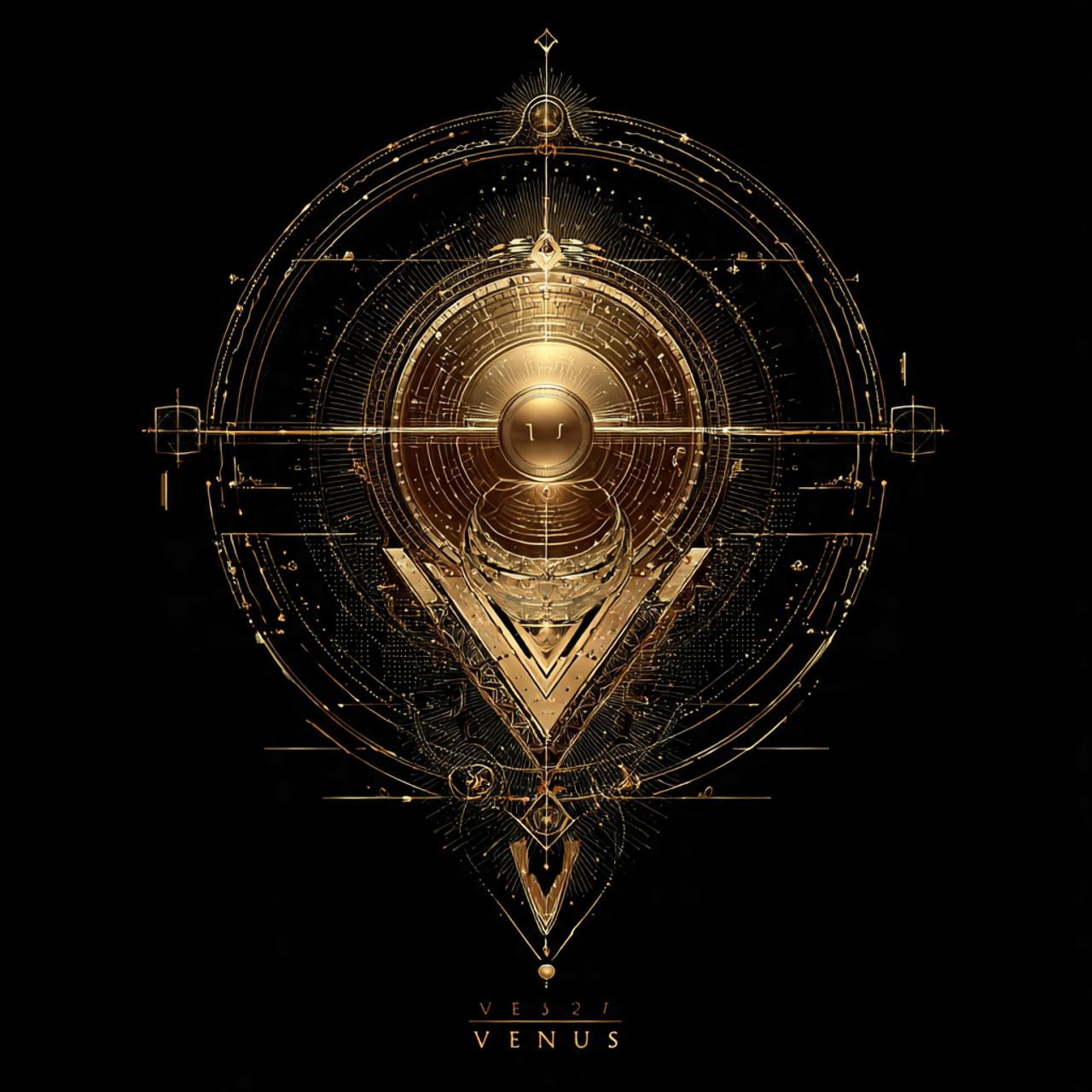
I. The Anatomy of ♀: Venus Symbol Meaning
The symbol for Venus (♀) is a masterpiece of geometric equilibrium. It consists of the circle of spirit placed above the cross of matter. This arrangement describes the spirit radiating down to illuminate and sanctify the physical world. While the modern world views this as simply the symbol for woman, its esoteric **Venus symbol meaning** is far broader: it is the principle of attraction, harmony, and the realization of beauty in form. Venus is the "Lesser Benefic," a key element in our planetary symbols guide, that brings sweetness to the human experience and reminds us that matter can be a vessel for the divine—a concept explored in the Hermetic law of correspondence.
The glyph is often likened to the hand-mirror of Aphrodite, but as a signature, it represents the heart-center. It is the centrifugal power of love that pulls contrasting elements into a unified whole. Venus is the principle of value, often analyzed in our Venus cycle analysis, representing that which draws us toward a state of higher integration and spiritualized matter.
II. The Magnetism of the Spirit
Venus governs the force of attraction that binds atoms, people, and galaxies together. She is the priestess of the senses, refining raw sensation into aesthetic appreciation.
To engage with Venus is to seek the common thread. She represents the "Law of Attraction" in its purest sense: that which we love, we become. But Venus is not merely passive; her magnetism is a powerful force of transformation. By elevating our desires (the cross) to serve our spirit (the circle), we turn base lust into spiritual devotion.
The symbol reminds us that the material world is not something to be escaped, but something to be beautiful. Through art, relationship, and the pursuit of justice, we "Venusianize" the earth, making it a more suitable reflection of the celestial realms.
The Keywords of Venus
- • Harmony and Balance
- • Attraction and Love
- • Beauty and Aesthetics
- • Relationship and Union
- • Value and Worth
- • The Copper of the Alchemist
III. Alchemical Copper: The Transmuted Heart
In alchemy, Venus corresponds to Copper—a metal that is high in conductivity and warm in color. Copper represents the stage of the work where the soul's emotional body is purified. It is the metal associated with the mirror because it must be polished to reflect the light clearly.
Venusian consciousness is the state of "Divine Appreciation." It is the ability to see the spark of God in all things. When the alchemist works with Copper, they are refining their capacity for empathy and their ability to perceive the hidden connections between seemingly separate entities. The "Copper of the Heart" must avoid the "green corrosion" of jealousy and possessiveness, striving instead for the pure, warm glow of selfless attraction.
IV. Venus in the Modern Landscape
Today, the Venus symbol is a ubiquitous marker of femininity and romance. However, in our commodity-driven culture, the deeper meaning of Venus as the principle of *absolute value* is often obscured. We equate beauty with surface appearance rather than with the integrity of the spirit shining through the form.
The Hermeticist seeks to reclaim the sacredness of beauty, recognizing it as a direct proof of the divine order. To contemplate the symbol of Venus is to re-evaluate our relationships—both with others and with our own material lives. It asks us to bring our "cross" into alignment with our "circle," ensuring that our presence in the world is a source of harmony rather than discord.
V. Historical Origins
The symbol of Venus, a circle atop a cross, finds its roots in the deep antiquity of Mesopotamian and Mediterranean civilizations. Long before it was standardized as a planetary glyph, the "Morning and Evening Star" was associated with Inanna in Sumer and Ishtar in Babylon. These cultures recognized the dual nature of Venus—as the herald of the day and the guardian of the dusk—mirroring her roles as the goddess of both war and love. The 8-pointed star, often associated with Ishtar, was the precursor to the more simplified geometric symbol we recognize today.
In the Greco-Roman period, the symbol became explicitly linked to Aphrodite-Venus. The Greeks refined the astronomical observations of the Sumerians, noting the "Pentagram of Venus"—the five synodic cycles that the planet completes every eight years, tracing a perfect star in the heavens. This celestial geometry solidified the link between the planet and the concept of "Divine Proportion" or the Golden Ratio. Ptolemy and other classical astronomers utilized the glyph as a shorthand for the planet's influence over the emotional and social spheres of human life.
During the Renaissance, Hermetic scholars like Marsilio Ficino and Cornelius Agrippa reinvestigated the symbol through the lens of Neoplatonism. They viewed the circle not just as a geometric shape, but as the *Monad*—the unified, perfect spirit—and the cross as the *Quaternary* of the elements. The symbol was seen as a mnemonic for the "Descent of the Spirit" into the four-fold world of matter, a necessary step for the manifestation of beauty and the experience of human connection.
VI. Symbolic Meaning
Beyond its astronomical utility, the Venus symbol is a profound glyph of psychological and spiritual integration. The **Circle of Spirit** represents the infinite, the unmanifest, and the eternal nature of the soul. It is the realm of pure potentiality and divine love. When this circle sits directly upon the **Cross of Matter** (representing the four elements: earth, air, fire, and water), it signifies a state where the material life is guided and uplifted by the spiritual.
This is in direct contrast to the symbol of [Mars](../symbols/mars-symbol.html), where the cross (or arrow) extends *outward* and *above* the circle, signifying the spirit's drive to conquer and assert itself upon the world. Venus is the principle of "Reactivity" and "Reception." In her glyph, there is no separation; the spirit is fully grounded and "at home" in the physical form. It is the symbol of the "Artful Life"—the belief that our bodies and our environments should be made as beautiful and as meaningful as our highest thoughts.
In the language of colors, Venus corresponds to the emerald green of nature and the soft rose of the dawn. In the language of geometry, she is associated with the pentagon and the circle. Together, these symbols speak of a universe that is fundamentally "Attractive"—a cosmos that pulls us toward excellence not through force, but through the irresistible allure of truth and beauty. To contemplate the ♀ is to remind the soul of its innate worth and its capacity to find harmony in even the most complex circumstances.
VII. Hermetic Interpretation
From a Hermetic perspective, the symbol of Venus is a primary illustration of the **Principle of Correspondence**: "As above, so below." Venus is the mirror that reflects the celestial beauty into the lower realms. She is the "Anima Mundi" or the World Soul in her most approachable form. The Hermeticist views the Venusian force as the "Glue of the Universe"—the *Eros* that prevents the disparate elements of creation from flying apart into chaos.
Venus also relates to the **Principle of Polarity**. She is the balancing force that reconciles the "Solar" and "Lunar" energies within the seeker. In the alchemical wedding, Venus acts as the bridge that allows the King and Queen to unite. She is the "Sweetness of the Work," ensuring that the rigorous process of transformation does not become dry or soul-crushing. Without the Venusian influence, the search for wisdom becomes a cold, intellectual exercise; with her, it becomes a living, breathing passion.
Furthermore, the symbol embodies the **Principle of Rhythm**. The retrograde loops of Venus and her phases as the Morning Star (Lucifer) and Evening Star (Hesperus) teach the Hermeticist about the ebb and flow of affection and value. We learn that there are times to reach out in attraction and times to withdraw into self-valuation. By aligning our personal rhythms with the cycle of Venus, we learn the art of "Sacred Timing" in our relationships and our creative endeavors.
VIII. Practical Application
In the practice of the Hermetic arts, the energy of Venus is utilized to foster peace, enhance aesthetic perception, and manifest abundance. On a psychological level, working with the Venus symbol involves the "Cultivation of the Heart." This is done through practices like the "Gratitude Journal" or the intentional creation of beauty in one's immediate surroundings. By focusing on what we value, we strengthen the "Venusian Magnet" within our own aura, naturally drawing toward us people and situations that resonate with our highest good.
In [Planetary Rituals](../rituals/planetary-invocations.html), the symbol of Venus is often inscribed on copper or green parchment during her day (Friday) and her hours. These invocations are not for the fulfillment of petty desires, but for the "Refinement of the Soul." The seeker asks to be made more receptive to the divine harmony and to be granted the grace to be a source of peace in the lives of others. The symbol acts as a focal point for the will, aligning it with the cosmic frequency of attraction and union.
For the modern seeker, the practical application of Venus is found in "Radical Self-Love"—the recognition that the "Circle of Spirit" is already present within us. When we stop seeking validation from the external "Cross of Matter" and instead realize our inherent divinity, we achieve the state of "Internal Venus." We become self-luminous, radiating harmony to all we encounter. This is the ultimate "Cosmetic" of the soul—the beauty that never fades because it is rooted in the eternal.
"Beauty is the splendor of Truth — and the Spirit's signature upon the world."