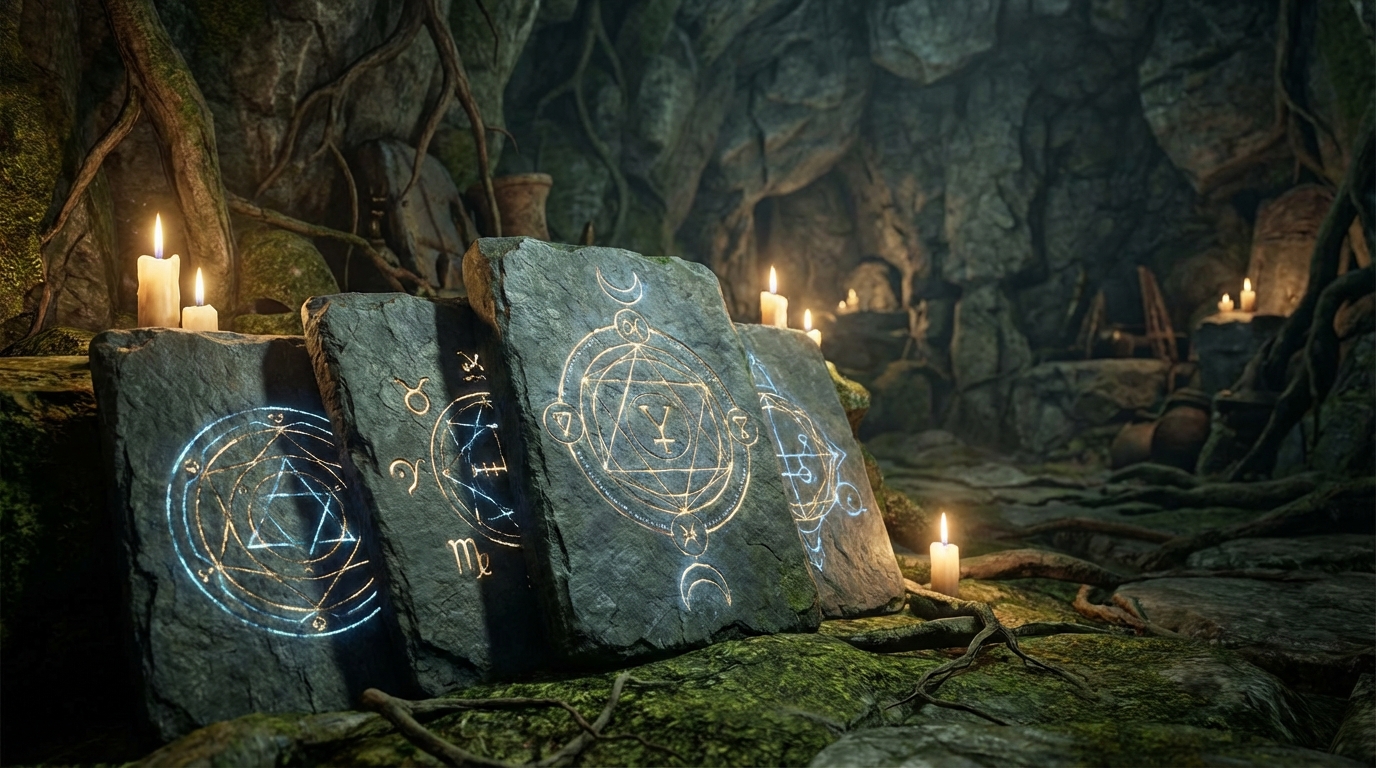
I. The Ontological Essence of Planetary Symbols and Meanings
This page examines planetary glyphs as a historical and structural system rather than as an individual-symbol lookup. It traces how the circle, crescent, and cross were combined into a symbolic grammar for planets, matter, soul, and spirit within the Hermetic Law of Correspondence .
Each glyph is constructed from three primary geometric components: the circle, the crescent, and the cross. Understanding these ratios is essential for navigating celestial cycles and planetary correspondences . The circle represents the spirit (limitless, eternal, and divine), the crescent represents the soul (the receptive, reflective, and fluctuating aspect of consciousness), and the cross represents matter (the four elements, the physical world, and the constraints of time and space). The specific arrangement of these elements reveals the relationship between spirit, soul, and body for that particular celestial intelligence.
II. The Seven Classical Archetypes
The Sun (☉): The Circle of Spirit
Represented by a circle with a dot at its center, the solar glyph is the ultimate symbol of the Monad. The circle is the spirit in its unformed state, while the dot represents the first point of form—the spark of divinity within the void. In alchemical terms, the Sun is the King, the source of vital heat (calidus), and the active principle of illumination. It is the ego-center, the 'I Am', and the sovereign intelligence that governs all other planetary spheres.
The Moon (☽): The Crescent of Soul
The lunar glyph consists entirely of the crescent, representing the receptive and reflective nature of the soul. Lacking the center point of the Sun, the Moon relies on the Light of Spirit to find its form. It governs the waters, the tides of the subconscious, and the rhythms of generation and decay. In the classical hierarchy, the Moon is the closest sphere to the Earth, serving as the gateway through which celestial influences must pass before they take form in the physical realm.
Saturn (♄): The Cross Above the Crescent
Saturn's glyph places the cross of matter above the crescent of soul. This configuration signifies the soul constrained by the heavy weight of material form, time (Chronos), and the law of cause and effect (Karma). Saturn is the Great Taskmaster, the dweller on the threshold, and the principle of limitation. Its symbol reminds us that wisdom is often forged in the fires of restriction and that the soul must master the physical plane before it can ascend to higher spheres.
Jupiter (♃): The Crescent Above the Cross
Conversely, Jupiter places the crescent of soul above the cross of matter. This symbolizes the soul expanding beyond material limitations. Jupiter is the principle of growth, optimism, and divine justice. It is the planet of benevolence and grace, where the spirit finds a way to sanctify the physical experience. Its glyph represents the release of potential and the aspiration toward higher social and spiritual laws.
III. The Triad of Power: Mars, Venus, and Mercury
While the Sun, Moon, Saturn, and Jupiter define the major poles of human experience, the inner planets (Mars, Venus, and Mercury) describe the specific dynamics of action, desire, and communication.
Mars (♂)
The Cross above the Circle
Matter driven by Spirit. The arrow indicates the outward projection of will. In the modern glyph, the cross has evolved into an arrow, emphasizing offensive action and the piercing of obstacles.
Venus (♀)
The Circle above the Cross
Spirit elevated above Matter. This is the symbol of harmony, attraction, and the sanctification of the material world through beauty and love. It is the perfect balance of the spirit illuminating form.
Mercury (☿)
Crescent, Circle, and Cross
The hermaphroditic union of all three components. Mercury is the messenger, the bridge between all worlds, and the principle of synthesis. It contains the potential of all other planets within its winged signature.
IV. Historical Transmission and Evolution
The history of these symbols traces a path through the Hellenistic world, where the fusion of Babylonian astrology and Greek philosophy gave birth to the system we recognize today. Medieval manuscripts preserved these glyphs with reverent precision, often embellishing them with calligraphic flourishes that hinted at their magical potency. Alchemists adopted the planetary symbols to represent the seven core metals: Lead (Saturn), Tin (Jupiter), Iron (Mars), Gold (Sun), Copper (Venus), Quicksilver (Mercury), and Silver (Moon).
In the contemporary era, while we use these symbols as mere markers on astronomical charts, the student of the mysteries recognizes them as keys to a vast library of celestial intelligence. To understand the planetary symbols is to begin the process of internalizing the cosmic order, aligning one's own internal 'planets' with the harmony of the spheres.
Each planetary symbol encodes a structural quality —
a recurring force that organizes timing, relationship, and behavioral pattern across a life. The force most persistently organizing yours has been operating longer than you have been aware of it. It has a precise name.
Reveal The PatternV. The Historical Evolution of Celestial Notation
The history of planetary symbols is a journey through the evolution of human consciousness and its attempt to map the unseen forces of the cosmos. The earliest forms of celestial notation were not symbols at all, but rather complex pictograms and ideograms found in the clay tablets of Sumer and Akkad. The planets were identified with specific deities—Nergal for Mars, Ishtar for Venus, Marduk for Jupiter—and their "signs" were often stylized versions of the deity's primary icon, such as Ishtar's eight-pointed star.
The transition from pictogram to the geometric glyphs we recognized today began in the Hellenistic period, specifically in the intellectual melting pot of Alexandria. Here, Greek geometry met Babylonian astrology, resulting in a systemic approach to celestial signatures. The astronomer Ptolemy and the Neoplatonist philosophers refined these marks, seeking a "Sacred Grammar" that could describe the ontological nature of the planets. By the Byzantine era, the symbols had largely stabilized into the forms we see in medieval manuscripts: the cross, the circle, and the crescent.
During the Renaissance, the Hermetic revival led by Marsilio Ficino and Pico della Mirandola breathed new life into these signatures. They were no longer viewed as mere abbreviations, but as "Talismanic Keys" capable of attracting the *Spiritus Mundi*—the spirit of the world. Each symbol was analyzed for its mathematical proportion and its relationship to the "Music of the Spheres." In the modern era, while science has reduced these glyphs to astronomical shorthand, the student of the mysteries recognizes them as the enduring language of the Soul, a universal code that transcends the barriers of time and culture.
VI. The Sacred Geometry of the Heptad
To understand the symbolic meaning of the planetary signs is to understand the **Sacred Geometry of the Heptad**—the seven classical planets that governed the ancient world. Each symbol is a meditation on the interplay between the Three Principles: Spirit (the Circle), Soul (the Crescent), and Matter (the Cross). When these elements are combined, they describe the "Great Chain of Being," mapping the descent of divinity into form and the eventual ascent of consciousness back to the source.
For example, in the symbol of [Venus](../symbols/venus-symbol.html), the spirit (circle) is elevated above matter (cross), signifying the victory of love and beauty over the density of the physical world. In contrast, the symbol of [Mars](../symbols/mars-symbol.html) places the cross (now an arrow) above the circle, representing the outward projection of spirit into the world of action. Mercury, the "Divine Androgyne," is the only glyph that integrates all three, signifying the perfect synthesis of all cosmic forces.
The orientation of these signs is also paramount. Vertical alignment suggests a hierarchy of influence, while horizontal components (rare in the primary glyphs) would suggest a state of equilibrium. Every stroke, and even the "absence" of a certain principle in a glyph—such as the lack of a cross in the solar and lunar symbols—is a profound theological statement. The planetary symbols are a "Mirror of the Soul," reflecting back to us the various stages of our own spiritual development and our relationship to the celestial harmonies.
VII. Hermetic Interpretation of the Celestial Signatures
In the light of the **Principle of Correspondence**, the planetary symbols are the "Grand Signatures" of the Anima Mundi. "As above, so below; as below, so above." The symbols tell us that the same geometric laws that govern the stars also govern the internal organs of the human body and the corridors of the human mind. The Hermeticist uses these symbols as "Lenses" through which to view the tapestry of reality, understanding that every event and every object is a localized expression of one or more of these seven celestial currents.
The symbols also embody the **Principle of Vibration**. Each planet "sings" in a specific frequency, and its symbol is the visual representation of that frequency. By meditating on the glyph of Jupiter, the seeker aligns their own internal frequency with the structural frequency of expansion and grace. By working with the glyph of Saturn, they align with the structural frequency of structure and law. This is the essence of **Theurgical Alchemy**—the art of using sacred symbols to re-tune the human instrument to the divine orchestra of the spheres.
Furthermore, the symbols relate to the **Principle of Mentalism**. "The ALL is MIND; The Universe is Mental." The planetary signs are the "Prototypes of Thought" within the Universal Mind. They are the fundamental ideas that give rise to the complexity of the material world. When we study the planetary symbols, we are peering into the blueprint of the Architect of the Universe. We are learning the "Language of the Logos," the primary code that translates the silence of the Absolute into the music of existence.
VIII. Practical Application in the Great Work
The practical application of planetary symbols lies in the realm of **Ritual Magic**, **Talismanic Art**, and **Personal Transformation**. The seeker uses these symbols to "Invoke" specific planetary energies into their sacred space. During a planetary ritual, the appropriate symbol is drawn on the ground, inscribed on candles, or visualized in the mind's eye to act as a "Portal" for the celestial intelligence. This is not for the sake of power, but for the sake of "Balance"—correcting the imbalances in one's own character by calling forth the corresponding celestial virtues.
In [Alchemical Practice](../correspondences/index.html), the planetary signs are used to label the various stages of the work and the substances involved. A flask marked with the symbol of Mercury is understood to contain the "Universal Solvent" of the soul, while one marked with Saturn contains the "Heavy Lead" of the initial descent. By utilizing these symbols, the alchemist maintains a constant awareness of the spiritual dimensions of their physical work, ensuring that the "Labor" is always also a "Prayer."
For the modern practitioner, the symbols are powerful tools for **Psychological Integration**. By identifying which planetary "archetype" is dominant in our lives, and which is lacking, we can use the symbols as focal points for change. If someone is stuck in a state of Saturnian melancholy, they might surround themselves with the symbols of Jupiter and the Sun to introduce the energies of expansion and illumination. By "Living with the Symbols," we allow their geometric power to subtly rewrite our subconscious scripts, aligning us more closely with the divine patterns of the cosmos.
"As above, so below; as below, so above." — The Emerald Tablet