Access Forbidden Wisdom
Explore the foundational texts of Hermetic and alchemical traditions.
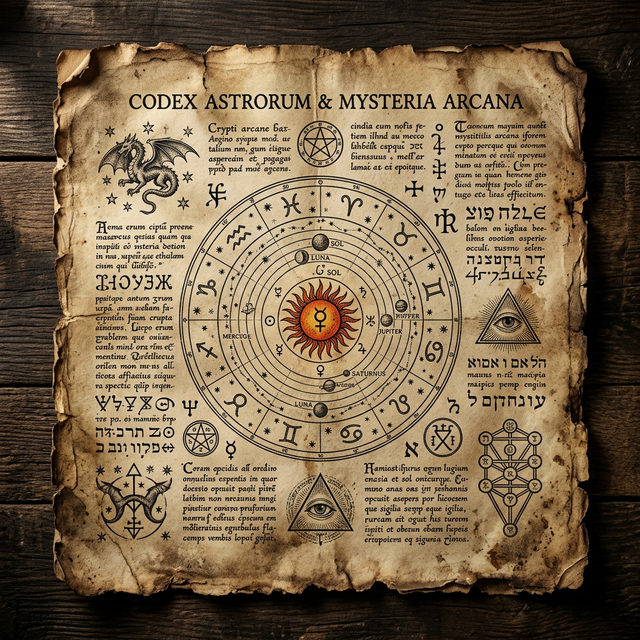
The Archive of the Ages: Preserving the sacred Sophia.
Historical Origins
The history of the Western esoteric tradition is essentially a history of the transmission of manuscripts. From the initial oral transmissions in the mystery schools of the Hellenistic world to the meticulous copying of papyri in Alexandria, the written word was seen as a vessel for the "Logos." The Corpus Hermeticum itself, attributed to the mythical Hermes Trismegistus, represents a synthesis of Egyptian wisdom and Greek philosophy that was nearly lost to time.
During the medieval period, while much of the Greco-Egyptian library was suppressed in the West, it was preserved and commented upon by Arab scholars in Baghdad and Cordoba. The eventual translation of these texts back into Latin during the Renaissance—most notably by Marsilio Ficino under the patronage of Cosimo de' Medici—triggered a cultural rebirth. To possess an ancient text was not merely to own a book; it was to hold a key to the primordial wisdom of humanity (Prisca Sapientia).
Symbolic Meaning
In the mystical tradition, a text is often viewed as a living organism or a "Mirror of the Soul." The letters and words are not merely markers of information but are seen as the "body" of a divine truth. The concept of the "Book of Nature" suggests that the entire universe is a text written by the hand of the Creator, and that the sacred scrolls are specific "maps" intended to help the initiate read that greater macrocosmic volume.
Every word in an alchemical or Hermetic manuscript often carries multiple densities of meaning. A simple instruction like "dissolve the stone" can be understood literally in a laboratory, psychologically as the dissolution of the ego, or cosmologically as the return of form to the primordial chaos. The text acts as a transformative catalyst, changing its message based on the spiritual maturity of the reader.
Hermetic Interpretation
Hermetic hermeneutics differs from literalist interpretation in its focus on "Gnosis" over dogma. To interpret a sacred text Hermetically is to seek the "spirit" behind the "letter." This involves a process of meditative contemplation where the reader seeks to align their own "Nous" with the "Nous" of the author. The goal is not just to understand what was said, but to *be* what was intended.
This tradition emphasizes the importance of silence and internal preparation before engaging with the texts. The reader is warned that the "mysteries" are hidden in plain sight, protected by the very simplicity of the language which the "profane" mind finds uninteresting or absurd. The true meaning of the Tabula Smaragdina (Emerald Tablet), for instance, cannot be found in its thirteen brief sentences alone, but in the internal resonance those sentences trigger in the practitioner.
Practical Application
The ancient practice of "Lectio Divina" or "Sacred Reading" remains a primary tool for modern practitioners. This involves a four-fold process: reading (lectio), meditation (meditatio), prayer (oratio), and contemplation (contemplatio). By slowing down the reading process, the text becomes a portal for a higher state of consciousness.
Furthermore, textual study is often paired with the practice of "Commonplacing"—maintaining a journal where significant passages are recorded and reflected upon. This creates a personalized "Florilegium" (a gathering of flowers), which acts as a portable altar of wisdom. In many traditions, the vocalization of certain passages (theurgy) is believed to harmonize the practitioner's vibration with the cosmic logs, serving as a form of verbal medicine or protection.
Related Concepts
- Paleography: The study of ancient writing systems and manuscripts, essential for understanding the transmission history of magical texts.
- Florilegia: Compilations of excerpts (the "flowers" of wisdom) from various texts used for spiritual education.
- Scholasticism: The structured method of learning and debate used in medieval universities to reconcile faith and reason.
- Scriptorium: The sacred workrooms of monasteries and occult societies where manuscripts were copied by hand.
Manuscript Pathways
Astrological Manuscripts
Source traditions for celestial timing, planetary order, and symbolic interpretation.
Chaldean Oracles
Theurgic fragments on ascent, divine fire, and the hidden structure of the soul.
Greek Magical Papyri
Ritual manuscripts preserving invocations, correspondences, and late antique practice.
Hermetic Fragments
Scattered Hermetic transmissions that preserve the edges of a wider teaching stream.
Medieval Grimoires
Later ritual handbooks shaped by astrology, angelology, and ceremonial magic.
Three Books of Occult Philosophy
Agrippa's synthesis of natural, celestial, and divine magic in the Renaissance archive.