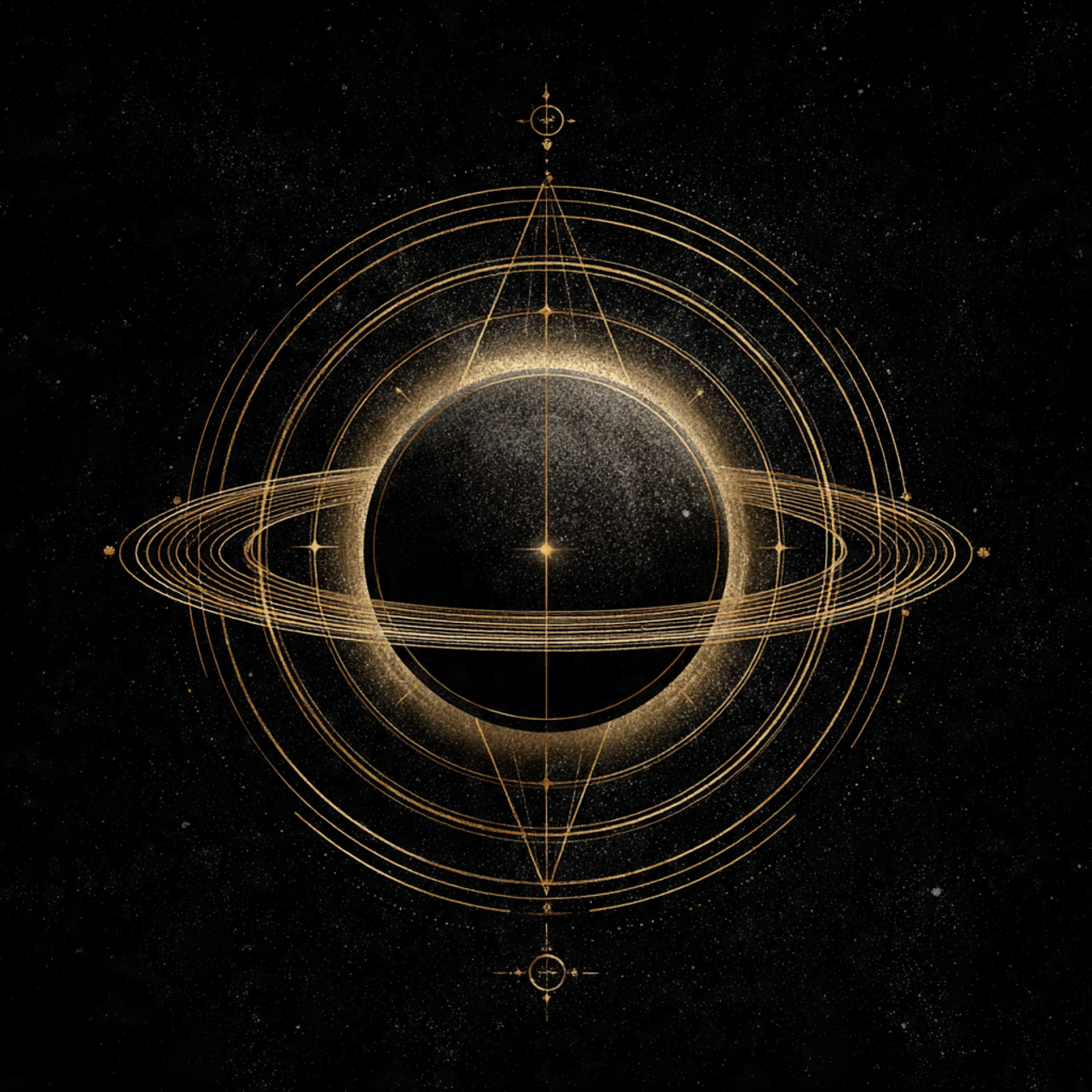
I. The Anatomy of the ♄: Saturn Symbol Meaning
The symbol for Saturn (♄) is one of the most sobering glyphs in the planetary alphabet. It is composed of the cross of matter placed directly above the crescent of the soul. In the language of celestial signatures, often discussed in our planetary symbols overview, this arrangement decribes the soul weighed down by the heavy constraints of the physical world, time, and mortality. Understanding the **Saturn symbol meaning** is crucial for any student of Hermeticism, as it represents the "Great Malefic" in traditional astrology, but in the internal mysteries—such as those found in our Saturn cycle study—he is the Great Teacher.
The glyph is often likened to the scythe of Chronos, the Greek god of time who devoured his own children. This imagery reflects the Saturnian principle of entropy, a core concept in the Hermetic law of correspondence: that which is born into time must eventually be consumed by time. However, the cross also represents the four elements and the four directions—the structural framework of reality. Saturn is the architect of the material world, the one who provides the boundaries within which the spirit can grow.
II. Saturn as the Dweller on the Threshold
In the classical geocentric model, Saturn was the outermost planet, the final boundary of the visible solar system. As such, he became the symbol of the 'limiting ring' or the threshold of the known.
To pass Saturn is to leave the realm of individual personality and enter the transpersonal, infinite depths of the Fixed Stars. But before one can pass, Saturn demands an accounting. He is the planetary judge, the lord of Karma who requires that we face our shadows and integrate our limitations.
His symbol reminds us that true freedom is not the absence of boundaries, but the mastery of them. By understanding the 'laws of the game' provided by Saturn, the initiate learns to operate within the material world with precision and wisdom, eventually using the very weight of the cross as a lever to elevate the soul.
The Keywords of Saturn
- • Limitation and Boundary
- • Structure and Discipline
- • Time and Aging
- • Contraction and Concentration
- • Wisdom through Suffering
- • The Lead of the Alchemist
III. Alchemical Lead: The Weight of Being
In alchemy, Saturn corresponds to Lead—the densest, dullest, and most 'dead' of the seven metals. The alchemical process always begins with Saturn (the Nigredo or blackening). Before the gold can be born, the lead must be found and purified. This symbolizes the "prima materia"—the raw, unrefined state of the human soul.
The symbol of Saturn is thus the starting point of the Great Work. We must descend into the darkness of the leaden state, embracing our limitations and fatalities, before we can begin the ascent toward solar illumination. Saturn is the 'Old King' who must die so that the young, golden king can be born. His scythe is not just a tool of destruction, but a tool of harvest—reaping that which has matured and clearing the field for a new cycle.
IV. Saturn in the Modern Psyche
Today, we experience the Saturn symbol through the archetype of the "Wise Old Man" (Senex) or the authority figure. It is the voice of conscience, the pressure of deadlines, and the inevitable reality of the body's aging. While these experiences can feel burdensome, the Hermeticist views them as essential "gravity" that prevents the spirit from drifting into useless abstraction.
The Saturn return, occurring every 29.5 years, is a period where the planetary signature manifests most strongly in an individual's life. It is a time of "reckoning" where we are asked whether we have built our lives on sand or on stone. To embrace the symbol of Saturn is to embrace responsibility, realizing that our choices in the material world carry eternal weight.
V. Historical Origins
The symbol of Saturn, the cross of matter surmounting the crescent of the soul, is a glyph that carries the deep, resonant echo of the primeval order. In the earliest recorded mythologies of the Fertile Crescent, the planet was identified with Ninurta, the Sumerian god of agriculture and war, who represented the stern necessity of the harvest and the unwavering laws of nature. The Babylonians called the planet *Mul-Kayamanu*, the "Steady One," noting its slow, measured progress across the sky—a celestial reminder of the inevitability of time and the weight of tradition.
In the Hellenistic world, the symbol became the mark of Chronos, the Titan who presided over the "Golden Age" but was also the personification of devouring Time. Ancient astronomers viewed Saturn as the "Greater Malefic," the planet of coldness and contraction, whose sublunary influence was responsible for the melancholic temperament. The symbol itself has evolved from a stylized pruning hook or scythe (the tool used to castrate Uranus and to reap the crops) into the precisely balanced ♄ of the medieval astro-alchemical manuscripts. It was the boundary mark of the known universe, the ultimate frontier beyond which lay the infinite, unmanifest void of the fixed stars.
Renaissance masters of the Hermetic arts, like Heinrich Cornelius Agrippa and Robert Fludd, viewed the Saturn symbol as the "Gateway to the Absolute." They understood that the cross above the crescent signifies that "Manifestation" (the cross) is the primary concern and burden of the Saturnian initiate. The soul (the crescent) is positioned below, suggesting that it must undergo a profound process of "Mortification" or weight-bearing before it can achieve liberation. The symbol was carved into lead plates and buried at the foundations of temples to ensure their longevity and to bind the project to the immutable laws of structure and time.
VI. Symbolic Meaning
Esoterically, the Saturn symbol represents the **Principle of Concentration**. It is the force that pulls the chaotic potential of the spirit into the specific, localized reality of form. If [Jupiter](../symbols/jupiter-symbol.html) is expansion and growth, Saturn is the "Ring-Pass-Not"—the boundary that prevents expansion from becoming dissipation. The cross at the top represents the 3D world of height, width, depth, and time, while the crescent below represents the soul's submissive relationship to these physical laws.
The vertical alignment of the symbol is a statement of **Hierarchy**. In the Saturnian system, nothing is accidental; everything has its place, its season, and its limit. This is the principle of **Fatalism** in its most constructive sense: the recognition that we are bound by the consequences of our past actions (Karma). In sacred geometry, Saturn corresponds to the number 3 (the triangle) in its most rigid form—the structure that cannot be moved or broken. It is the "Anchor of the Cosmos," the gravitational pull that allows the other planets to maintain their orbits.
Symbolically, Saturn is linked to the color black and the deep, silent gray of stone. He corresponds to the sense of hearing (the perception of vibration and law) and the faculty of the memory. When we contemplate the ♄, we are contemplating our own "Mortality." We are reminded that our time on earth is limited and that we are responsible for the legacy we leave behind. The symbol is a call to "Internal Architecture"—the process of building a character that is as solid and as enduring as the mountains. It is the signature of the "Old Soul" who has learned through the rigorous school of experience that true power comes through the mastery of one's own limitations.
VII. Hermetic Interpretation
The Saturn symbol is the definitive illustration of the **Principle of Correspondence**: "As above, so below; as below, so above." Saturn is the planetary representative of the "Great Void" (Binah in the Kabbalah)—the dark mother who provides the form for the light of the spirit. The Hermeticist understands that the "Cross of Matter" is not a prison, but a sacred vessel. By aligning one's life with the cosmic laws represented by Saturn, the initiate transforms their "Chain of Fate" into a "Ladder of Ascent."
Saturn also embodies the **Principle of Cause and Effect**. He is the "Lord of Justice" who ensures that every action is met with its equal and opposite reaction. In the Great Work, Saturn is the "Nigredo"—the essential stage of blackening and decomposition. Without the pressure and coldness of Saturn, the "Alchemical King" cannot find the stillness required for transformation. The ♄ is the signature of the "Patient Worker," the one who understands that "God moves slowly, but he sees everything."
Finally, the symbol relates to the **Principle of Mentalism**. Saturn represents the "Structure of the Mind"—the discipline and focus that allow a thought to become a thing. He is the "Mental Framework" that provides the boundaries for creative expression. By mastering the Saturnian current, the Hermeticist gains the ability to concentrate their mental force until it becomes as dense and as impactful as a physical object. The symbol of Saturn is the key to the "Alchemy of Time"—the ability to use the slow, grinding movement of the years to refine the soul into a diamond.
VIII. Practical Application
Practically, the energy of Saturn is invoked to build structures, to establish discipline, to protect boundaries, and to gain wisdom from the past. Working with the Saturn symbol involves the "Cultivation of Silence and Solitude." This is done through practices like fasting, meditation on one's mortality (Memento Mori), and the rigorous fulfillment of one's duties. By embracing the "Cold and Dry" nature of Saturn, we clear away the emotional clutter that prevents us from seeing the truth of our situation.
In [Planetary Rituals](../rituals/planetary-invocations.html), the symbol of Saturn is inscribed on lead or black stone during the hour of Saturn on Saturdays. These rituals are not for the timid; they are designed to confront the "Dweller on the Threshold"—the sum total of one's own unintegrated karma and fears. The symbol acts as a "Stabilizer," providing the grounding necessary to face these shadows without being consumed by them. It is also used in agricultural magic to ensure the hardiness of crops and in architectural magic to ensure the stability of buildings.
For the modern seeker, the practical application of Saturn is found in "Digital Minimalism" and the "Reclamation of Time." By intentionally setting limits on our consumption and our commitments, we regain our sovereignty over our own lives. The symbol of Saturn reminds us that "No" is a sacred word. By holding the ♄ in our awareness, we commit ourselves to the "Long Game"—the slow, steady progress toward our highest potential. We become the "Masters of the Cross," using the very limitations of our lives as the skeletal structure upon which we hang the skin of our spiritual manifestion.
"Under the heavy weight of Saturn, the diamond of the soul is forged."