The 7 Hermetic Principles Explained
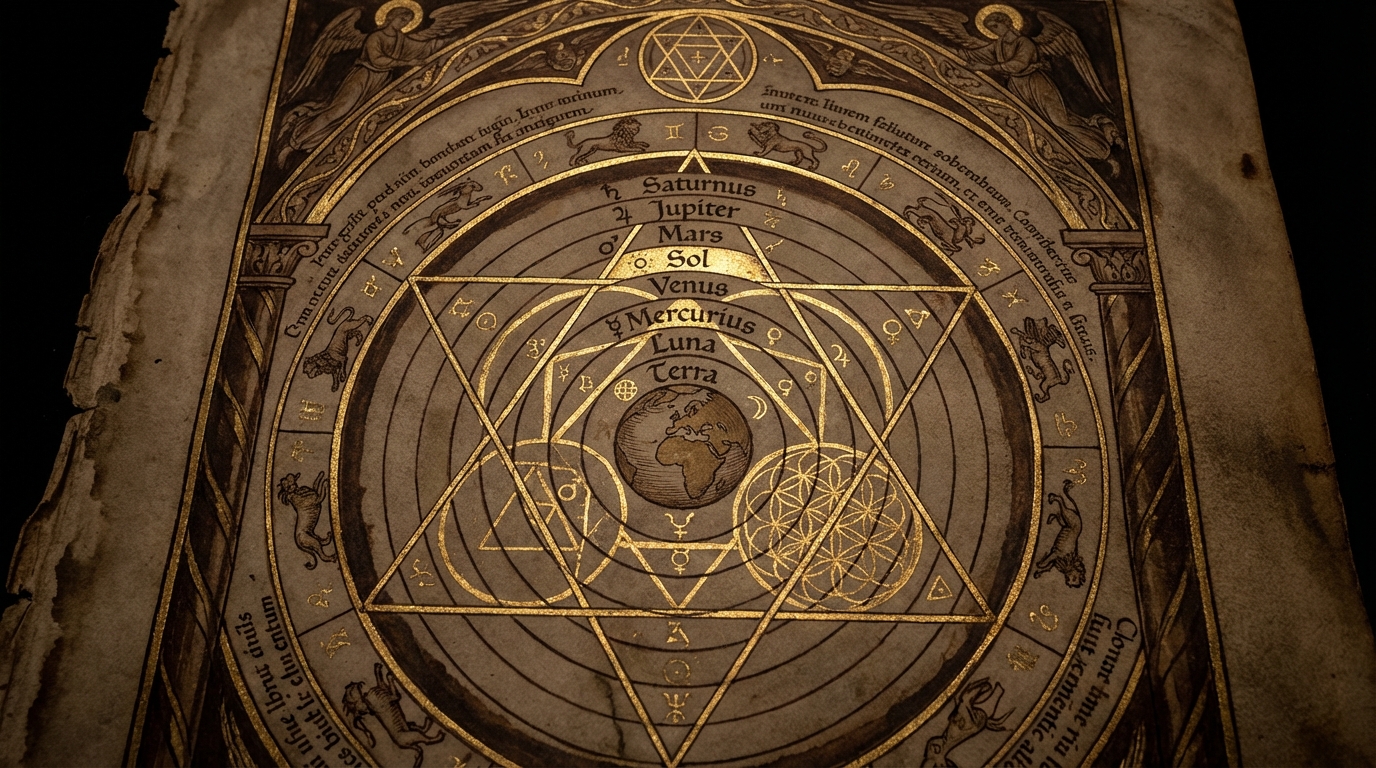
The seven pillars of Hermetic philosophy.
A Guide to Universal Patterns
The Hermetic philosophy is an ancient spiritual, philosophical, and magical tradition. Tracing its roots to Hellenistic Egypt, the core teachings of Hermeticism are attributed to the legendary figure Hermes Trismegistus, a syncretic combination of the Greek god Hermes and the Egyptian god Thoth. For centuries, these teachings have influenced countless esoteric schools, mystical orders, and individual seekers pursuing a deeper understanding of reality.
At the very heart of this vast philosophical framework lie seven fundamental axioms—often simply called the Seven Hermetic Principles. These laws are described as the immutable patterns that govern the structure, movement, and behavior of everything in the universe, from the grandest cosmic cycles down to the smallest psychological fluctuations within the human mind. This is the foundation for understanding repeating life cycles and the mirror of reality. For many, these laws clarify why life feels stuck when misalignment occurs.
See Your Pattern Live
Start Your Oracle Reading →By studying and internalizing these seven principles, the Hermetic student seeks to align themselves with the fundamental operations of nature. Rather than being continuously buffeted by the chaotic winds of circumstance, one learns to recognize the underlying currents of cause and effect, rhythm, and polarity, thereby gaining a measure of mastery over one's own destiny and internal state. This alignment is reflected in the mathematical blueprint of everything we experience.
In This Article
1. The Principle of Mentalism
The first Hermetic principle posits that "The All is Mind; the Universe is Mental." This profound axiom suggests that the foundational substance of the universe is not physical matter or empty space, but rather a living, infinite, and universal Mind. In this view, everything that we perceive as objective reality is ultimately a manifestation or projection of an underlying consciousness.
According to this teaching, the cosmos operates much like a massive, collective thought spanning eternity. Matter, energy, and power are all subordinate to the mastery of Mind. Because the universe itself is mental in nature, it is susceptible to the influence of mind—meaning that conscious intention, concentrated thought, and mental alchemy are not just psychological tricks, but forces capable of interacting directly with the fabric of reality.
Practical application of Mentalism involves recognizing that true change always begins inwardly. Before a situation can be transformed in the material world, it must first be transmuted in the mental realm. By changing one's thoughts, paradigms, and states of consciousness, the Hermetic practitioner begins to gently but inevitably alter the external conditions they experience.
2. The Principle of Correspondence
Perhaps the most famous of all Hermetic teachings, the Principle of Correspondence is elegantly summarized in the axiom: "As above, so below; as below, so above." This law states that there is an unbroken harmony and agreement spanning multiple planes of existense—the physical, the mental, and the spiritual.
Because the laws of the universe are consistent across all scales, observing the microcosm allows one to understand the macrocosm, and vice-versa. The patterns seen in the orbit of planets around a star are reflected in the structure of atoms, and the seasonal changes observed in nature have direct energetic parallels within the emotional and psychological cycles of a human being.
This principle undergirds the ancient sciences of astrology and alchemy. Astrologers look to the heavens not because rocks floating in space force us to act in particular ways, but because the celestial patterns perfectly correspond to the psychic and archetypal conditions unfolding on Earth at any given moment. The universe is a grand fractal of interconnected meaning.
3. The Principle of Vibration
The Principle of Vibration declares: "Nothing rests; everything moves; everything vibrates." Thousands of years before modern quantum physics arrived at the same conclusion, Hermetic philosophers asserted that the universe is entirely composed of motion and frequency. Even the densest, most seemingly solid physical objects are merely vibrating energy.
The primary difference between various states of matter, emotion, and spiritual reality is simply a difference in frequency. At the lowest end of the spectrum is dense physical matter vibrating extremely slowly, while at the highest end lies the pure spirit, vibrating with such absolute intensity that it appears almost completely at rest.
Understanding the Principle of Vibration allows the Hermetic student to engage in mental and emotional alchemy. By consciously raising the frequency of one's own thoughts and emotional states—shifting from fear or anger to love, courage, or stillness—one naturally alters their resonance, profoundly affecting both their inner experience and their interaction with the external world.
4. The Principle of Polarity
In the Hermetic worldview, "Everything is dual; everything has poles; everything has its pair of opposites." The Principle of Polarity explains that all manifested things have two sides or two extremes, and that opposites are actually identical in ultimate nature, differing only in degree.
For example, heat and cold are not fundamentally different phenomena; they are simply varying degrees of temperature on the same continuum. Similarly, light and darkness, love and hate, or courage and fear operate on the same spectrum. There is no absolute line marking where one ends and the other begins.
This principle provides the key to one of the most practical forms of mental transmutation. Because seemingly opposed emotions are actually just different ends of the same pole, it is possible to slide one's consciousness along that specific continuum. An adept does not try to destroy fear; rather, they consciously shift its vibration along the pole, transmuting fear into its opposite—courage.
5. The Principle of Rhythm
Tightly interwoven with Polarity, the Principle of Rhythm states that "Everything flows, out and in; everything has its tides; all things rise and fall." This law describes the perpetual pendulum swing of reality—the cyclic movement between opposing poles that characterizes all of existence.
We see rhythm everywhere: the rise and fall of empires, the cycling of the seasons, the inhale and exhale of breath, and the alternating periods of high enthusiasm and deep rest in our personal lives. The pendulum of motion invariably swings to the right, and then swings equally to the left. The measure of the swing to the right is the exact measure of the swing to the left.
While an individual cannot stop the cosmic principle of Rhythm, the Hermetic adept learns how to master it through polarization. By rising to a higher plane of consciousness—observing the swing rather than being emotionally tethered to its weight—the adept neutralizes the negative effects of the backward swing, allowing them to remain firm and steadfast even when circumstances decline.
6. The Principle of Cause and Effect
The sixth principle asserts that "Every Cause has its Effect; every Effect has its Cause; everything happens according to Law." The Hermetics teach that chance or coincidence does not exist. While an event may seem random from a limited perspective, there are always unseen causes operating behind it.
In a universe governed by absolute law, nothing falls outside the chain of causality. The masses of humanity generally exist as the "effects" of the world around them—their moods, choices, and destinies heavily shaped by their environment, the people they surround themselves with, and their own unexamined subconscious programming.
The goal of the Hermeticist is to rise above the plane of simple effect and become a conscious Cause. By mastering one's mind, taking supreme responsibility for one's actions, and understanding the laws of the universe, an individual begins to direct their own life, intentionally setting vast chains of cause and effect into motion to achieve a desired outcome.
7. The Principle of Gender
The final principle states that "Gender is in everything; everything has its Masculine and Feminine Principles; Gender manifests on all planes." In the Hermetic context, Gender is not merely equivalent to physical, biological sex; rather, it refers to the dual principles of generation, creation, and manifestation inherent in all things.
The Masculine principle is generally characterized by penetrative, directive, outgoing, and initiating energy. The Feminine principle is characterized by receptive, gestating, formative, and nurturing energy. Neither principle is superior; they are deeply interdependent. New creation—whether it be biological, artistic, or psychological—can only easily occur when the two forces work together in harmony.
In the mental and spiritual realms, this principle explains the mechanics of creation. The conscious, directive mind (Masculine) projects the seed of an idea or intention into the subconscious, receptive mind (Feminine), which then gestates and materializes that thought into reality. Recognizing and balancing these forces within oneself is seen as a crucial step toward complete holistic mastery. Understanding these internal forces is often the first step in seeing why your life keeps repeating itself.
Related Insights
Consult the ARCANUM Oracle
If this keeps happening, it’s not coincidence. There is a pattern behind it — one you are not fully seeing yet. The Oracle reveals what is repeating and why.
Invoke the OracleGet Your Personal Cycle Report
Your birth date reveals more than patterns. Unlock your full cycle interpretation instantly.
Reveal Your Full Reading →