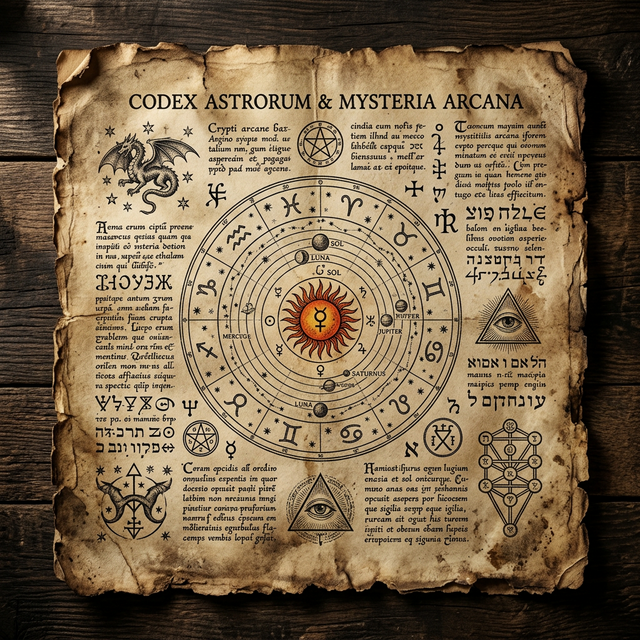
I. The Renaissance Magna Carta of Magic
Heinrich Cornelius Agrippa von Nettesheim's *De Occulta Philosophia Libri Tres* (Three Books of Occult Philosophy), published in 1533, is the most important textbook of magic in the Western world. Agrippa, a polymath who was simultaneously a doctor, lawyer, soldier, and theologian, sought to redeem the reputation of magic. He argued that magic was not "black arts" but the summit of all philosophy and science—the bridge between the human and the divine.
The *Three Books* functioned as a massive synthesis of all existing esoteric knowledge, organizing the chaotic traditions of the medieval era into a coherent, intellectual system. Agrippa's work remains the foundational reference for modern Western occultism, cited by everyone from the Golden Dawn to modern Chaos Magicians.
II. The Three Fold Structure of Reality
Agrippa organized his work into three books, reflecting the three worlds through which the human being must ascend.
Book I: Natural Magic. This deals with the elemental world—the hidden properties of stones, herbs, and animals. Agrippa explains how the "Occult Virtues" of things are derived from the World-Soul and how the magician can use these virtues to effect changes in the physical world.
Book II: Celestial Magic. This focuses on the mathematical world—astrology, numbers, and geometric forms. This book contains the famous "Magic Squares" of the planets and the seals of the celestial spirits. It teaches that the universe is structured by number and that harmony is the law of the stars.
Book III: Ceremonial Magic. The highest level, dealing with the divine world—angels, demons, and the names of God. This is the realm of *Theurgy*, where the soul communicate directly with higher intelligences through sacred ritual and prayer.
Core Agrippan Teachings
- • Occult Virtues: The hidden powers of nature.
- • Planetary Squares (Kameas): Mathematical grids of power.
- • Angelic Hierarchies: The ranks of divine messengers.
- • The Scalæ (Scales): Correspondences in numbers.
- • Dignity of the Magician: The moral requirement for magic.
III. The Image of Man: The Microcosm
At the heart of the *Three Books* is the concept of Man as the "Microcosm." Agrippa provided detailed diagrams showing how the human body reflects the geometry of the circle and the square—a direct influence on Leonardo da Vinci's *Vitruvian Man*.
Agrippa argued that because the human being contains all levels of reality within themselves—body (elements), soul (spheres), and spirit (intellect)—they have the "right" to interact with all levels of the universe. The magician is the one who has awakened this internal hierarchy. Magic is not something done *to* the world; it is something done *through* the self. As Agrippa famously wrote, "The mind is the scepter that governs the world."
IV. The Moral Burden of the Art
Agrippa was deeply concerned with the character of the practitioner. He warned that magic is a dangerous tool in the hands of the ignorant or the immoral. To be a true magus, one must be a "holy and devout person," dedicated to the service of God and the benefit of humanity.
This ethical dimension is what separates Agrippa from the common "sorcerers" of his time. He saw magic as a path of *sanctification*. By studying the secrets of nature and the heavens, the magician is drawn closer to the Creator. The ultimate "Magic" is the restoration of the human being to their original, divine status before the Fall—the *Apocatastasis*.
The Oracle identifies what repetition hides.
Symbolic diagnosis reveals the deeper architecture beneath recurring emotional loops.
Begin The DiagnosisV. Heritage and Controversy
Agrippa's life was one of constant struggle. He was persecuted by the Church and accused of witchcraft. Even his legendary "Black Dog" was rumored to be a demon in disguise. Yet, his *Three Books* were never successfully banned because they were built on an unassailable foundation of high philosophy and deep scholarship.
Today, the *Three Books of Occult Philosophy* are essential reading for anyone serious about the Western Mystery Tradition. They represent a high-water mark of human aspiration—the belief that the universe is purposeful, beautiful, and completely accessible to the dedicated seeker of truth. Agrippa remains the "Father of Modern Magic," and his library is still the primary map for our exploration of the hidden realms.
VI. The Journey of the Nettesheim Archive
The historical emergence of *De Occulta Philosophia Libri Tres* is as dramatic as the life of its author, Heinrich Cornelius Agrippa. Born in 1486, Agrippa completed the first draft of this monumental work in 1510, while still in his early twenties. He circulated it in manuscript form among the intellectual elite of Europe—including the humanist Trithemius of Spanheim—for over two decades before finally daring to publish the full, expanded version in 1533. This delay was a strategic necessity; the work was a revolutionary attempt to synthesize the "Forbidden Sciences" of the Middle Ages with the high Humanism of the Renaissance, placing it directly in the crosshairs of the Inquisition.
Agrippa’s magnum opus was not written in a vacuum. It was a rigorous response to the works of Marsilio Ficino and Giovanni Pico della Mirandola, intended to provide the "Complete Engineering Schematics" for the theories they had proposed. By organizing magic into three distinct but interlocking "Worlds"—the Elemental, the Celestial, and the Intellectual—Agrippa created a taxonomic masterpiece that allowed for the systematic study of the hidden world. Despite being labeled a "Conjuror of Demons" by his detractors and living a life of exile and poverty, Agrippa’s work became the primary source for every major occult tradition that followed, from the French occult revival of Eliphas Lévi to the modern Hermetic orders of the 21st century.
Today, the *Three Books of Occult Philosophy* are recognized by historians as a crucial turning point in the history of science. Agrippa was one of the first to argue that "Magic" was actually "Natural Science" whose laws had not yet been fully cataloged. His work paved the way for the scientific revolution by emphasizing the mechanical and mathematical nature of the universe. To study Agrippa is to witness the birth of the modern mind, where the spiritual and the material are viewed as two sides of a single, rational, and completely explorable reality.
VII. The Metaphysics of the "Universal Mirror"
Esoterically, the *Three Books* are a study of **Ontological Hierarchy**. The central symbol of the text is the "Ladder of Being," a concept that posits that power flows from the Divine Mind down through the celestial spheres and into the material elements. Agrippa teaches that the world is a "Universal Mirror," where every object on earth reflects a higher, spiritual reality. The goal of the magus is to "Climb the Mirror," tracing the reflection back to its source. This is the **Alchemical Ascent of Consciousness**, where the practitioner moves from the manipulation of physical herbs and stones to the command of planetary spirits and, finally, to communion with the divine names.
The symbol of the **Magic Square (Kamea)** is another core element of the Agrippan system. These mathematical grids (3x3 for Saturn, 4x4 for Jupiter, etc.) represent the "Mathematical DNA" of the planets. To Agrippa, numbers were not just quantities but "Qualities of the Soul of the World." By translating these numbers into sigils and seals, the magician is creating a "Numerical Link" with the planetary governor. The square acts as a **Harmonic Resonator**, vibrating at the exact frequency of the celestial power it represents, allowing the magician to "Broadcast" their intention into the astral plane with mathematical precision.
Through these symbols, Agrippa teaches that the human being is the **Supreme Mediator**. We are the "Point of Convergence" between the three worlds. The symbol of the [Vitruvian Man](../texts/three-books-of-occult-philosophy.html#the-image-of-man-the-microcosm) is not just a study of anatomy, but a declaration of "Spiritual Sovereignty." To study the *Three Books* is to engage in **Macrocosmic Integration**, learning how to use the entire universe as an extension of one's own nervous system, transforming the seeker into a "Living Axis" around which the three worlds revolve in perfect harmony.
VIII. Hermetic Interpretation of the Agrippan Synthesis
The *Three Books of Occult Philosophy* are a vivid expression of the **Principle of Mentalism**. "The ALL is MIND; the Universe is Mental." Agrippa takes this principle and applies it to the training of the magician. He argues that the "Imagination" is the primary tool of the work—not as fantasy, but as the "Plastic Power of the Soul" that can shape the World-Soul itself. The Hermeticist understands that the rituals described in Book III are methods for "Directing the Mental Flow." By aligning the individual mind with the Divine Mind through the use of sacred names, the magician becomes a co-creator, participating in the ongoing mental manifestation of the universe.
The work also embodies the **Principle of Correspondence**. Agrippa provides the most exhaustive "Tables of Correspondences" in history, linking everything from the smells of plants to the hierarchy of angels. These tables are the "Language of the Microcosm." The Hermeticist recognizes that the "Magic" happens when the practitioner "Speaks in Correspondence"—bringing together the correct number, color, and name to create a perfect "Symbolic Sentence." This is the secret of **Hermetic Synthesis**—the ability to find the one underlying law that governs the diversity of the three worlds, as described in the [Corpus Hermeticum](../texts/corpus-hermeticum.html).
Finally, the text relates to the **Principle of Vibration**. Agrippa explains how words, music, and even the "Vibrations of the Stars" affect the human soul. He describes the "Occult Virtues" as specific "Frequencies of Power" that can be captured and utilized. The magician is essentially a "Vibrational Engineer," learning how to raise or lower the "Tone" of an environment to attract certain spiritual forces. This relates to the [Seven Vowels](../texts/greek-magical-papyri.html#symbolic-meaning) and the Orphic singing, proving that the Agrippan system is the ultimate "Harmonic Integration" of the entire Western esoteric tradition.
IX. Practical Occultism: Navigating the Three Worlds
In practical Hermeticism, the *Three Books* are used for **Sigil Construction**, **Planetary Charms**, and **Angelic Communication**. The "Agrippan Method" involves a systematic progression. We begin with the *Natural* (Book I)—learning to use herbs and stones to stabilize our health and environment. We then move to the *Celestial* (Book II)—using the Kameas to create talismans that align our personal fortune with the lucky rays of Jupiter or the protective shield of Mars. This is the **Alchemical Strengthening of the Aura**, preparing the seeker for the intense spiritual energies of the third world.
In [Modern Ritual Practice](../rituals/index.html), the "Invocations of the Intelligence" from Book III are used to establish contact with higher spiritual forces. These rituals are not about "Commanding" spirits, but about "Inviting the Teacher." The practitioner uses the sacred names and symbols as "Telephonic Numbers" to call upon the specific Angelic Intelligence that governs a particular area of knowledge. This is the **Theurgical Opening of the Gate**, a method for receiving direct instruction and guidance from the celestial realms.
For the modern practitioner, the practical application is found in "Total System Awareness." We begin to see our life as a "Triple-Layered Reality." The symbol of the [Vitruvian Man](../texts/three-books-of-occult-philosophy.html#the-image-of-man-the-microcosm) reminds us that we are the "Master-Key" that opens all doors. By holding the teachings of Agrippa in our awareness, we transform our everyday actions into a "Philosophical Rite." We become the "Co-Architects of the Divine Order," carrying the library of Nettesheim into the digital age, ensuring that the ancient science of the soul remains a living, effective, and rational force for all who seek the path of the Light.
"No one can be a magus who is not first a philosopher."
Agrippa's three books organized occult knowledge into a structural system — the natural, the celestial, the intellectual. The system most relevant to your recurring experience is not one of these three. It is the pattern that has been organizing your life across all three registers simultaneously.