I. Defining the Grammar of Magic
The word "grimoire" shares its origin with "grammar." Both refer to a structured system of rules for effective communication. While a standard grammar allows us to speak with each other, a grimoire allows the magician to "speak" with the unseen forces of the universe—the angels, demons, and spirits that inhabit the celestial and infernal hierarchies.
From the 13th to the 18th centuries, these manuals were the "forbidden books" of the Western world. Often falsely attributed to mythic figures like King Solomon, Pope Leo, or Albertus Magnus, the grimoires were produced primarily by the "clerici"—low-level church officials who possessed literacy, knowledge of ritual, and a deep-seated curiosity about the hidden powers of the divine name. In the ARCANUM archive, we study these texts as the "underground engineering" of Medieval spirituality.
II. The Solomonic Tradition: Power and Authority
The vast majority of medieval grimoires cluster around the legendary figure of King Solomon, who was said to have received a ring from an angel that gave him power over all spirits.
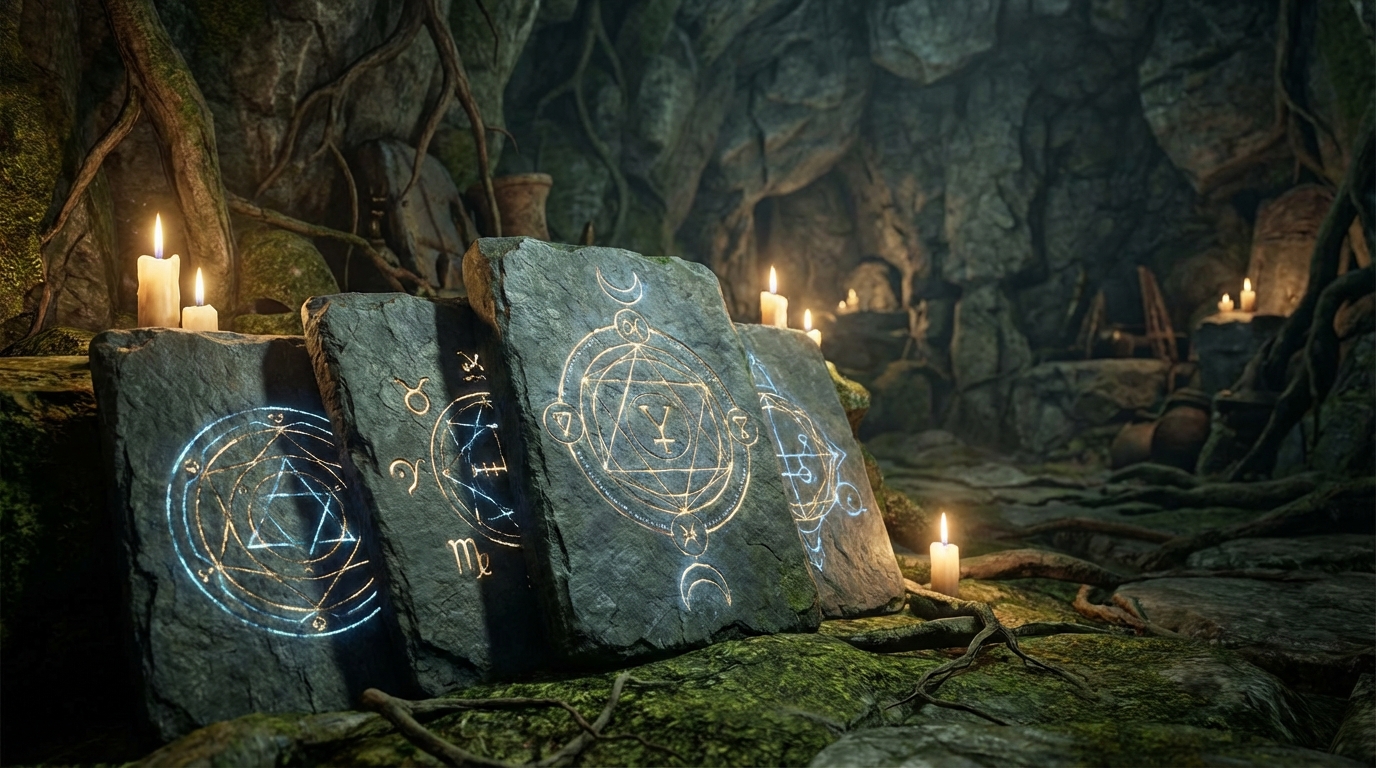
The Key of Solomon (Clavicula Salomonis): This is the prototype. It focuses on the creation of various "Pentacles"—complex geometric seals that captureplanetary power and provide protection for the magician. It emphasizes the "Dignity" of the practitioner, requiring long periods of fasting, prayer, and ritual purification.
The Lemegeton (Lesser Key of Solomon): Famous for the *Goetia*, which lists 72 spirits of the brazen vessel. This book is a detailed "Who's Who" of the invisible world, providing the specific seals and conjurations for each entity. It represents the "Engineering" side of magic—how to bind and task complex entities toward a specific goal.
Core Grimoire Elements
- • Conjuration: The formal call to spirit.
- • The Magic Circle: The boundary of protection.
- • Seal/Sigil: The spiritual signature of the entity.
- • Constraints: Binding the spirit to the mission.
- • License to Depart: Releasing the energy safely.
III. The Sworn Book of Honorius: The High Theurgy
While books like the *Goetia* deal with the lower entities, others like the *Liber Juratus* (Sworn Book of Honorius) are purely "high magic." Allegedly written by a council of 81 magicians to preserve their knowledge from the Inquisition, this text focuses on the Beatific Vision—the direct experience of God.
The *Sworn Book* is a rigorous system of long-term ritual that includes the "Seal of God" (Sigillum Dei Aemeth). It teaches that by systematically purifying the soul and invoking the various angelic hierarchies, the magician can eventually witness the divine face. This is the bridge between the grimoire tradition and the higher Neoplatonic theurgy, proving that even in the "dark" Middle Ages, the light of Gnosis remained a primary objective.
IV. The Psychology of the Circle
Modern occultists, influenced by C.G. Jung, often view the grimoires through a psychological lens. They argue that the "demons" listed in the *Goetia* are personifications of the human shadow—the repressed or unintegrated parts of the self. By "evoking" them into a "triangle of manifestation" outside of the sacred "circle" of the integrated self, the magician is able to communicate with these parts and bring them into alignment with the conscious will.
Whether viewed as external spirits or internal archetypes, the grimoire rituals provide a powerful technology for "Self-Refinement." The precision required by the texts acts as a focus for the chaotic human mind, allowing the practitioner to achieve states of intense clarity and purpose that are rarely accessible in mundane life.
V. The Enduring Legacy
The grimoire tradition never truly died. It morphed into the "Black Books of the North" in Iceland, the "Grands Grimoires" of France, and eventually the highly refined systems of the 19th-century occult revival. Today, the "Grimoire Revival" is one of the most vibrant areas of esoteric study, with practitioners re-examining the original manuscripts and testing their efficacy in the modern world.
To study a grimoire is to encounter the "Brave New World" of the Medieval mind. It is to find a world where the human will is a cosmic force, where the names of God have physical weight, and where the boundaries between the seen and the unseen are paper-thin. In the ARCANUM archive, we preserve these texts not as "spells," but as the historical evidence of humanity's refusal to be bound by the limitations of the material world.
VI. The Underground Stream: A History of Forbidden Ink
The historical narrative of the medieval grimoires is a tale of survival and subversion. These texts were not the products of isolated cults but were often written and copied within the very institutions that publicly condemned them. During the 13th and 14th centuries, a "Magical Underground" flourished among the literati of Europe—clerics, students, and court officials who were disillusioned by the rigid boundaries of official theology. These individuals sought a more direct, "Technical" relationship with the divine and the demonic. They viewed the grimoire not as a work of heresy, but as an expansion of natural philosophy, utilizing the linguistic and ritual tools provided by the Church to explore the "Hidden Architecture" of the world.
The Solomonic tradition, which forms the core of this movement, was a multicultural fusion. It drew from Jewish Merkabah mysticism, Islamic astrological magic (such as the [Picatrix](../texts/picatrix.html)), and Byzantine angelology. By the time the *Lemegeton* and the *Key of Solomon* reached their final forms in the late Renaissance, they had become sophisticated syntheses of over a millennium of ritual practice. The authors used the "Authority of Solomon" as a literary shield, claiming that their magic was a divine heritage intended for the "Wise and the Pure." This historical persistence shows that the human urge to "Map the Abyss" was stronger than the fear of ecclesiastical punishment, preserving a unique record of the "Dark Gnosis" that accompanied the more visible Scholasticism of the Middle Ages.
In the 18th and 19th centuries, the grimoire tradition was rescued from obscurity by the pioneers of the occult revival, most notably S.L. MacGregor Mathers of the Golden Dawn. He painstakingly translated and edited the major Solomonic texts, stripping away centuries of scribal errors and restoring them to a usable, coherent state. Today, the study of medieval grimoires is no longer limited to "dabblers" in the black arts; it is a serious field of academic research that reveals the complex, often contradictory relationship between religion, science, and the human imagination in the pre-modern world.
VII. The Metaphysics of the "Sacred Perimeter"
Esoterically, the medieval grimoires are a study of **Ontological Boundary Management**. The central symbol of the tradition is the **Magic Circle**. To the uninitiated, the circle is a mere protective shield; but to the theurgist, it is a "Microscopic Model of the Divine Mind." Standing within the circle, the magician symbolically occupies the "Center of the Universe"—the point of the Source. The names of God and the seals of the angels inscribed around the perimeter are the "Walls of the City of God." The circle teaches that the human being is only safe and powerful when they are perfectly centered in their own divine nature, separated from the dualities and chaos of the external "Wilderness."
The symbol of the **Seal or Sigil** is another core element. Each spirit—be it an angel of the [Three Books of Occult Philosophy](../texts/three-books-of-occult-philosophy.html) or a demon of the *Goetia*—possesses a unique geometric signature. This is the spirit's "Vibrational Address." By drawing the seal, the magician is performing a form of **Symbolic Capture**. The seal is a "Physical Anchor" for a non-physical intelligence. It represents the belief that the intellectual world can be mastered through the manipulation of form and number. The seal is the "Key" that fits into the "Lock" of the spirit's nature, allowing the magician to open a channel of communication without being overwhelmed by the spirit's raw essence.
Through these symbols, the grimoires teach that the universe is a **Labyrinth of Intentionality**. The "Demons" are not just evil monsters, but "Distortions of Will" that must be brought back into the order of the One. The "Angels" are the "Corrected Frequencies" of that same will. To study a medieval grimoire is to engage in **Ontological Re-alignment**, using the specific names and signs of the tradition to "Correct the Map" of one's own soul, transforming the "Demonic" aspects of the psyche into "Angelic" messengers of the Light.
VIII. Hermetic Interpretation of the Underground Arcana
The medieval grimoires are a vivid expression of the **Principle of Mentalism**. "The ALL is MIND." The Grimoire practitioner understands that the "Spirits" are not separate, solid entities, but "Mental Forms" within the vast consciousness of the World-Soul. The ritual is a method for "Programming the Mind." By using the "Constraint of the Divine Names," the magician is actually using the highest part of their own mind (the Spark of God) to command the lower, more chaotic parts of their subconscious (the Goetic spirits). The Hermeticist recognizes that the entire ritual setup—the robes, the incense, the circle—is a "Mnemonic Theater" designed to raise the magician's consciousness to the level of the Source.
The work also embodies the **Principle of Cause and Effect**. The grimoires emphasize that "Every Spirit has its Office." This is the recognition that every force in the universe has a specific function and a specific "Cost." The magician is a "Cosmic Accountant," learning which force to call upon for which effect. The [Law of Correspondence](../correspondences/index.html) is applied here with surgical precision: if you want a certain result (Effect), you must find the spirit whose nature (Cause) corresponds to that result. The rituals are not "Pleas for Mercy" but the "Execution of Universal Law," as explained in the foundational layers of the [Corpus Hermeticum](../texts/corpus-hermeticum.html).
Finally, the grimoires relate to the **Principle of Polarity**. They present a universe of dualities: Angels vs. Demons, Light vs. Dark, Above vs. Below. However, the goal of the "Master of the Circle" is to stand at the **Neutral Point**. By commanding both the "Infernal" and the "Celestial" spirits using the same divine names, the magician integration the poles. They recognize that the "Demons" are merely "Fallen Angels"—energies that have been moved out of their proper rhythm. The ritual of "Refining the Spirit" is an alchemical process of **Polar Restoration**, bringing the shadow back into the light of the conscious will.
IX. Practical Grimoire Magic: Commanding the Shadow
In practical Hermeticism, the medieval grimoires are used for **Shadow Integration**, **Talismanic Protection**, and **Will-Fortification**. The "Grimoire Method" involves the use of *Constraints and Conjurations*. The practitioner theurgically "Clings to the Divine" (the Name of the Source) while speaking to the "Spirit." This is a method for "Negotiating with the Subconscious." By treating a repressed fear or desired outcome as an "Entity" with a specific name and seal, the seeker can engage with it objectively, "Binding" its negative qualities and "Releasing" its positive potential. This is the **Alchemical Distillation of the Psyche**, transforming raw impulse into refined purpose.
In [Daily Ritual Life](../rituals/index.html), the symbols of the grimoires—such as the *Pentacles of Solomon*—are used as "Visual Reminders of Sovereignty." Carrying a pentacle of Mars is a method for "Hardening the Personal Perimeter" against external interference. The practitioner also uses the *License to Depart* as a fundamental mental health tool: the ability to "Close the Gate" on a thought-form or obsession when its work is done. This is the **Practical Governance of Reality**, ensuring that the seeker remains the "Governor of the Circle" rather than a victim of the wandering spirits of the mind.
For the modern practitioner, the practical application is found in "Ritual Responsibility." We begin to see our words as "Conjurations." The symbol of the [Magic Circle](../texts/medieval-grimoires.html#the-psychology-of-the-circle) reminds us that we are the "Architects of the Boundary." By holding the teachings of the medieval grimoires in our awareness, we transform our everyday struggles into a "Theurgical Drama." We become the "Lords of the Threshold," carrying the grammars of the Solomonic scribes into the complexity of the 21st century, ensuring that the ancient science of the soul remains a living, effective, and protective force for all who dare to speak the Name.
"By the power of the Divine Names, I open the Way."