I. Discovery of the Underground Archive
The *Papyri Graecae Magicae* (PGM), or the *Greek Magical Papyri*, represent a stunning archaeological find that changed our understanding of ancient spiritual practice. Discovered in Egypt during the 19th century—most notably through the Anastasi collection—these documents are not theoretical treatises like the *Corpus Hermeticum*. Instead, they are the "workbooks" of practicing magicians who lived between the 2nd century BCE and the 5th century CE.
These scrolls were often buried with their owners, intended to guide them through the afterlife or buried to keep them safe from the authorities of the emerging Christian state. They provide a raw, unedited glimpse into the multicultural melting pot of Roman Egypt, where Greek, Egyptian, Jewish, and even Babylonian influences combined to create a unique and powerful system of practical magic.
II. The PGM as Syncretic Grimoire
The PGM is famous for its "Barbarous Names of Evocation" and its complex blending of deities. A single spell might call upon Helios, Osiris, IAO (Jehovah), and Mithras in the same breath.
This syncretism reflects the cosmopolitan nature of the ancient Mediterranean. Magicians of the time were "Universalists"—they believed that all names for the divine pointed to the same underlying forces. If an Egyptian name for a solar deity worked, they used it. If a Jewish name for the divine creator brought results, they incorporated it.
What emerges from the PGM is a technique of Theurgy—the art of divine communication. The rituals range from simple "folk magic" for love or wealth to profound mystical invocations meant to achieve union with a "Personal Daimon" or to see the face of God during a "Solar Rite."
Core Ritual Components
- • Voces Magicae: Untranslatable strings of power-words.
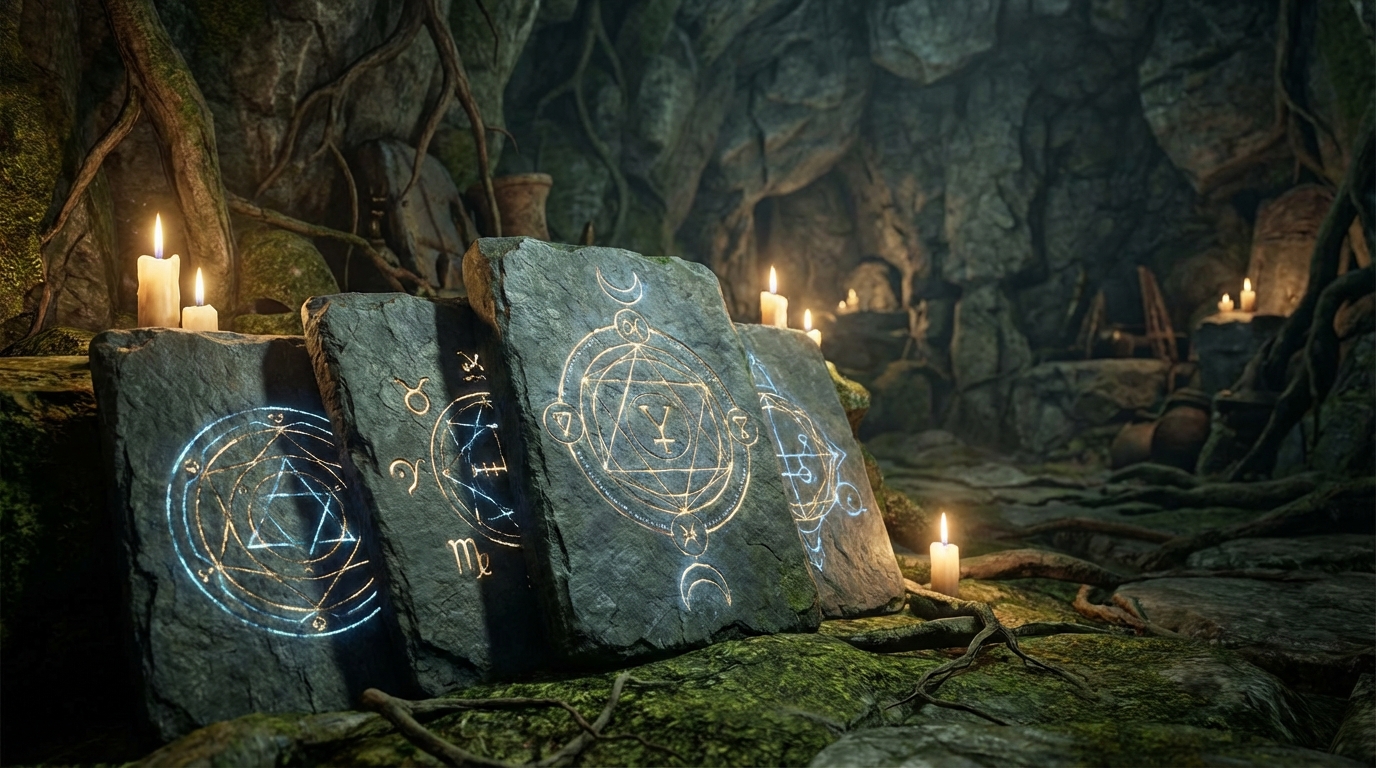
- • Charakteres: Secret seal-symbols used to bind spirits.
- • Incense & Offerings: Precise lists for each planet.
- • Vowel Chanting: Harmonic resonance based on Greek vowels.
- • The Palingenesia: Rituals of symbolic rebirth.
III. The Mithras Liturgy & The Headless One
Two of the most famous sections of the PGM are the Mithras Liturgy and the Invocation of the Headless One (Akephalos). The Liturgy details a ritual for the ascension of the soul through the planetary spheres to witness the "Great God Helios-Mithras." It is a rare example of a survivor from the ancient mystery cults, providing a step-by-step guide for achieving the "Seven-fold Immortality."
The Headless One invocation—later adapted by Aleister Crowley as the "Preliminary Invocation of the Goetia"—is an absolute masterpiece of ancient ritual poetry. It addresses a primordial, unbegotten god that lies behind all other names. This ritual is designed to align the magician's will with the "One Mind," granting them authority over the spirits of the air and the depths.
IV. Practical Magic vs. Higher Mysticism
The PGM has often been dismissed by scholars of "high" philosophy as mere superstition. However, to the Hermeticist, there is no such divide. The practical spells for health, protection, and legal matters are seen as the "outer temple" work, ensuring that the magician has a stable material life in which to perform the "inner temple" work of mystical union.
The papyri teach that the universe is alive and responsive. By learning the correct names, hours, and signs, the human can interact with the celestial choir. This is not about "controlling" the gods, but about learning to "vibrate" in harmony with them. The PGM provides the musical score for this divine symphony.
V. The Living Stream
After being lost for over a millennium, the PGM has enjoyed a massive resurgence in the 21st century. It has become the primary source for the "Hermetic Revival" and the "Greco-Egyptian Magic" movement. Modern practitioners find in these papyri a dynamic, flexible, and deeply effective system that bypasses the rigid structures of later medieval grimoires.
To study the *Greek Magical Papyri* is to stand in the presence of the ancient sages. It is to hear the voices of men and women who spoke to the gods and expected an answer. It remains a foundational archive for anyone who believes that the spiritual and the practical are one and the same—a living testament to the endurance of the human will to touch the divine.
VI. The Archive of the Shadow Priests
The historical saga of the *Greek Magical Papyri* (PGM) is a detective story of monumental proportions. These documents did not originate in a single library, but were collected piece by piece by entrepreneurs in the 19th century, most notably Giovanni d'Anastasi, a Swedish-Greek merchant in Alexandria. He amassed a massive collection of scrolls from the Theban region, which were eventually split among the great museums of Europe—London, Berlin, and Paris. For decades, these papyri were viewed as "Degenerate" remnants of a dying culture, but modern scholarship has revealed them to be the survival of a sophisticated, localized ritual tradition that thrived beneath the surface of official religious life.
The authors of the PGM were likely members of the lower clergy—Egyptian temple scribes—who were losing their state funding as the Roman Empire transitioned to Christianity. These individuals were the "Intellectual Entrepreneurs" of their age, preserving the ancient liturgical traditions of Egypt by adapting them to the needs of a diverse, Greek-speaking clientele. By incorporating Jewish names of power and Greek philosophical concepts, they created a "Universal Magic" that was both ancient and modern. The papyri arrive from a world on the brink of total transformation, serving as a time capsule for a "Sacred Technology" that would have otherwise been erased by the changing tides of history.
In the 20th century, the translation work of Karl Preisendanz and later Hans Dieter Betz transformed the PGM from an obscure curiosity into a foundational text for the study of religion. Today, the *Greek Magical Papyri* are recognized as the primary source for the "Western Grimoire Tradition." They show us that magic was not a peripheral superstition, but a vital part of the daily life of the ancient Mediterranean, providing a bridge between the high philosophy of the philosophers and the visceral needs of the common person.
VII. The Metaphysics of the Barbarous Names
Esoterically, the *Greek Magical Papyri* are a study of **Vibrational Resonance**. The most striking symbol within the text is the use of the *Voces Magicae*—strings of seemingly nonsensical syllables like *ERETHIKI* or *PHTHRE*. To the uninitiated, these are "Barbarous Names," but to the practitioner, they are **Logos-Vibrations**. They represent the "Unuttered Language" of the universe, the raw frequencies that predate human speech. By reciting these names, the magician is not trying to "Persuade" a spirit, but to "Tune" their own consciousness to a specific cosmic frequency, allowing them to participate in the creative power of the One.
The symbol of the **Seven Vowels** (ΑΕΗΙΟΥΩ) is another core element of the PGM. In ancient Greek thought, the seven vowels corresponded to the seven planetary spheres. The PGM contains elaborate instructions for chanting these vowels in specific patterns—breathing deeply, looking in specific directions, and using specific tones. This is a form of **Harmonic Theurgy**. The magician's body becomes a "Musical Instrument," and the vowel-chants are the "Notes" that harmonically align the microcosm (the human) with the macrocosm (the universe). This is the origin of the belief that sound is the primary medium through which the spiritual world manifests in the material.
Through these symbols, the PGM teaches that the universe is a **Labyrinth of Intelligent Forces**. The deities mentioned in the text—Helios, Hecate, Typhon, and IAO—are not separate entities but "Nodal Points" within a single web of energy. The symbols and ceremonies are the "Geometric Keys" that unlock the doorways between these nodes. To study the *Greek Magical Papyri* is to engage in **Ontological Networking**, learning how to move through the hidden passageways of the soul to access the infinite resources of the divine mind.
VIII. Hermetic Interpretation of the Magical Arts
The *Greek Magical Papyri* are a vivid expression of the **Principle of Correspondence**. "As Above, So Below." The papyri take this principle and apply it with clinical precision. If the Sun is at a certain angle, a certain herb is picked, and a certain name is spoken, the result must follow because the universe is a single, integrated machine. The Hermeticist understands that the PGM rituals are a method for "Activating the Correspondence." By creating a "Perfect Image" of a celestial event on earth, the magician draws the power of that event into their own life.
The texts also embody the **Principle of Vibration**. Many of the spells involve intense physical and vocal exertion—shouting, whispering, and distinct breathing patterns. The PGM recognizes that the spiritual world is reached not through belief, but through the **Shift of Frequency**. The spells are "Instruction Manuals for Vibration," teaching the practitioner how to raise their own energy level until it breaks through the "Threshold of the Mundane." This is the secret of the "Solar Rite" in the PGM—the literal "Igniting" of the spirit until it shines with the light of the Father.
Finally, the PGM relates to the **Principle of Cause and Effect**. They describe how the magician can "Bind" or "Release" the forces of fate. However, the higher rituals within the collection, such as the *Palingenesia* (Immortalization), aim for a different goal: the attainment of **Divine Autonomy**. The magician seeks to become a "Causal Force" in their own right. By aligning with the "Headless One"—the god without a name—the seeker moves from being a subject of the Law of Cause and Effect to being a "Messenger of the Law," participating in the divine governance of the world described in the most profound layers of the papyri.
IX. Practical Ritual: The PGM in the Modern Laboratory
In practical Hermeticism, the *Greek Magical Papyri* are used for **Sigil Construction**, **Venerative Hymns**, and **Theurgical Rebirth**. The "PGM Method" involves the use of *Charakteres*—sacred seal-symbols that were believed to be the "Visual Names" of the gods. The modern practitioner uses these symbols to create "Point of Contact" talismans, drawing the specific planetary or stellar energies into physical form. This is the **Alchemical Fixation** of the spirit, providing a stable foundation for the seeker's magical and mundane activities.
In [Daily Rites](../rituals/index.html), the "Hymns of the PGM" are used to open the gateways of the heart. These poetic evocations are not requests for favors, but "Songs of Alignment." Reciting the *Hymn to Helios* or the *Invocation of Selene* is a method for "Synchronizing the Internal Cycles" with the cosmic rhythms. The practitioner learns to "Speak the Language of the Abyss," using the *Voces Magicae* to silence the analytical mind and allow the "Deep Mind" to emerge. This is the primary practical application of the PGM—the transformation of the human voice into a "Divine Tool."
For the modern practitioner, the practical application is found in "Ritual Sovereignty." We begin to see our life's desires and obstacles as "Magical Potentials." The symbol of the [Headless One](../texts/greek-magical-papyri.html#the-mithras-liturgy--the-headless-one) reminds us that we are the "Primordial Spirit" acting through a human frame. By holding the teachings of the *Greek Magical Papyri* in our awareness, we transform our everyday actions into a "Theurgical Drama." We become the "Architects of Resonance," carrying the voices of the Anastasi scrolls into the heart of the 21st century, ensuring that the ancient science of the soul remains a living, effective force for all who dare to call upon the Light.
"I am the Spirit of the unbegotten one."