I. Tracing the Light of the Mind
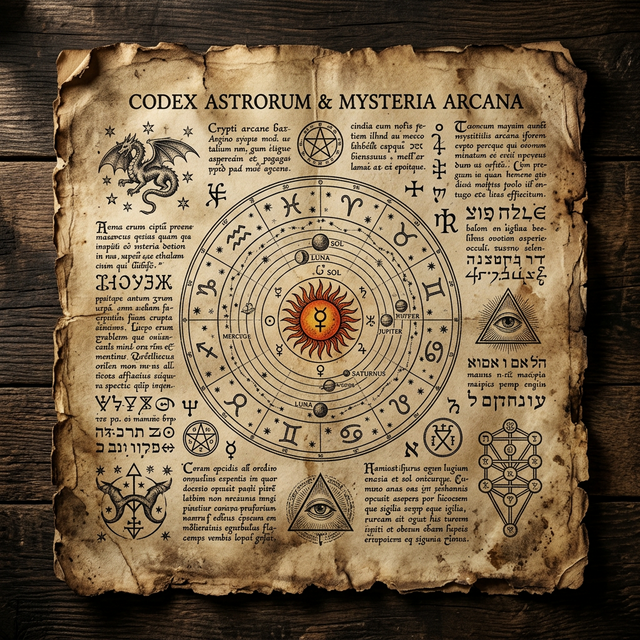
The history of astrology is a history of the written word. For over four thousand years, the observations of the stars have been meticulously recorded, analyzed, and passed down through a lineage of manuscripts that span from the clay tablets of Babylon to the illuminated vellum of Medieval Europe. These manuscripts are not just data sets; they are the records of a profound philosophical inquiry: the search for the relationship between the macrocosm and the microcosm.
In the ARCANUM archive, we view these manuscripts as a "living body" of knowledge. Each era—ancient Hellenistic, medieval Arabic, and Renaissance Latin—added its own layers of complexity and insight. Together, they form a comprehensive map of the human experience as reflected in the mirror of the heavens.
II. The Foundational Pillars
Four major works stand out as the primary pillars of the Western astrological tradition.
The Tetrabiblos (Ptolemy): Composed in the 2nd century CE, this is the "Bible" of rational astrology. Ptolemy sought to explain astrology through natural philosophy, treating it as a physical science based on the "occult" qualities of heat, moisture, and dryness.
The Anthology (Vettius Valens): A raw, practical manual from the same era. While Ptolemy was theoretical, Valens was a working astrologer. His manuscript is filled with hundreds of real horoscopes from his clients, providing a direct look at the stresses and aspirations of the ancient world.
The Liber Astronomiae (Guido Bonatti): The most influential medieval text. Bonatti was the advisor to Frederick II, and his work represents the "High Scholastic" period of astrology, where the art was integrated with Aristotelian logic and complex mathematical "lots."
Key Manuscript Traditions
- • Babylonian: Omen-based, state-driven focus.
- • Hellenistic: Birth of the individual horoscope.
- • Arabic: Mastery of horary and medical astrology.
- • Latin: Synthesis with Christian theology.
- • Renaissance: Integration with humanism and art.
III. The Arabic Bridge: The Wisdom of Baghdad
During the "Dark Ages" in Europe, the flame of astrology was kept alive in the Islamic world. Manuscripts by authors like Abu Ma'shar and Al-Biruni expanded the field into new areas: mundane astrology (the fate of nations) and the use of the "Lunar Mansions" for magical purposes.
The Arabic manuscripts introduced a level of mathematical precision and philosophical depth that had been lost in the West. When these works were translated into Latin in the 12th century, they triggered the Intellectual Renaissance. The "Arabic Parts"—mathematical points between two planets—remain a testament to this era's obsession with finding the hidden structural logic of fate.
IV. The Philosophy of the Starry Script
The manuscripts consistently argue that astrology is a language. The "Signs" are not just symbols; they are the letters of a divine script. By learning to read this script, the individual gains a unique level of self-knowledge. Plotinus, the great Neoplatonist, argued that the stars do not "cause" things to happen; rather, they are "signs" that indicate the current state of the World-Soul.
In this view, the horoscope is a "Blueprint of Potential." The manuscripts teach that while we are born with certain predispositions (fate), we have the "spark of mind" (free will) to choose how we manifest those energies. Astrology is thus a tool for liberation—by knowing our "stars," we can eventually rise above their deterministic influence.
V. The Digital Archive: Preserving the Future
In the 21st century, these manuscripts are undergoing a new transformation. Projects like the *Corpus Hermeticum Astrologicum* and the various manuscript digitizations are making these rare texts accessible to everyone. We are currently in a "Golden Age" of astrological research, where the ancient techniques are being tested against modern data.
To study an astrological manuscript is to participate in one of humanity's longest-running intellectual projects. It is to recognize that we are not isolated islands, but part of a cosmic ecosystem. The manuscripts remind us that time is not just a linear crawl, but a recurring cycle of quality and meaning—and that the map of that meaning is always available, if we only know how to read the stars.
VI. The Genealogical Stream of the Starry Scrolls
The historical lineage of the Western astrological manuscript tradition is a multi-generational relay race that spans continents and languages. It began with the systematic Babylonian "Omen-Series," such as the *Enuma Anu Enlil*, which served as the primitive data-set for celestial observation. This knowledge was transmitted to the Hellenistic world following the conquests of Alexander the Great, where it was refined into the mathematical system of "Genethlialogy" (horoscopy) by Greek poymaths. The watershed moment was the 2nd century CE, when Ptolemy’s *Tetrabiblos* and Vettius Valens’ *Anthology* established the twin tracks of astrology: the theoretical and the practical.
Following the collapse of Rome, the manuscript tradition found a more fertile home in the Abbasid Caliphate. Scholars in Baghdad translated the Greek texts and synthesized them with Persian and Indian concepts, creating the sophisticated "Grand Conjunction" theories of Abu Ma'shar. These Arabic manuscripts, which emphasized the technical use of "Lots" and "Primary Directions," were eventually smuggled back into Europe during the 12th-century translation movement. This re-introduction of the starry script was the catalyst for the development of medieval Scholasticism, where astrologer-clerics like Guido Bonatti organized the tradition into massive, encyclopedic volumes that influenced everyone from the royal court of Frederick II to the poetic architecture of Dante’s *Divine Comedy*.
In the Renaissance, the tradition reached its aesthetic peak. Manuscripts like the *Lilly Library’s Christian Astrology* or the various illuminated *Decan-Cycles* represented the integration of astrology with the new spirit of Humanism. Today, the study of these manuscripts is undergoing a "Technological Renaissance." Computational linguistics and high-resolution imaging are allowing modern researchers to reconstruct the lost techniques of the Hellenistic masters. To study these manuscripts is to realize that astrology has always been a "Cumulative Science," where each era contributes a new layer of observation to the foundational map of the soul.
VII. The Metaphysics of the "Celestial Clockwork"
Esoterically, the astrological manuscripts are a study of **Cyclical Synchronicity**. The central symbol of the tradition is the **Horoscope Wheel**, a geometric division of the circle into twelve "Houses." This wheel is not just a chart; it is a "Chronological Mandala" representing the totality of the human life-cycle. Each segment of the wheel corresponds to a specific area of existence (Self, Assets, Communication, etc.). The manuscripts teach that the wheel is a "Mirror of the Soul's Journey," where the movement of the planets through the houses symbolizes the "Activating Potential" of different life-lessons at different times.
The symbol of the **Aspect**—the geometric relationship between two planets (Trine, Square, Sextile)—is another core element. To the ancient scribes, an aspect was a "Conversation" between two cosmic intelligence. A trine (120 degrees) represented a state of **Harmonic Resonance**, where the two forces work together in a flow of ease. A square (90 degrees) represented a state of **Frictional Evolution**, where the two forces challenge each other to produce a new level of awareness. This is the **Alchemical Geometry of Fate**, a method for understanding how the various "Parts" of our nature interact to create the singular experience of our destiny.
Through these symbols, the manuscripts teach that the universe is an **Intelligent Machine of Meaning**. The planets are the "Gears," the signs are the "Lubricant," and the mathematician-astrologer is the "Clock-Watcher." The symbol of the [Arabic Parts](../texts/astrological-manuscripts.html#the-arabic-bridge-the-wisdom-of-baghdad) reminds us that within the massive patterns of the stars, there are "Hidden Points of Destiny" that can only be found through precise observation. To study the astrological manuscripts is to engage in **Ontological Navigation**, learning how to read the "Script of the Stars" to find the optimal path through the waves of time.
VIII. Hermetic Interpretation of the Starry Script
The astrological manuscripts are the ultimate practical application of the **Principle of Correspondence**. "As Above, So Below." The Hermeticist understands that the "Stars" are not just distant gas-balls, but "Celestial Sigils" whose movements mirror the internal movements of the human psyche. The manuscripts provide the "Translation Guide" for this mirroring. When a manuscript describes the "Exaltation of the Sun," the Hermeticist reads it as the "Peak of the Creative Will" in the seeker's own soul. This is the secret of **Hermetic Synchronicity**—the realization that we are not "Affected" by the stars, but "Inseparable" from them, moving in the same rhythm as the Father of All described in the [Corpus Hermeticum](../texts/corpus-hermeticum.html).
The work also embodies the **Principle of Polarity**. The manuscripts are obsessed with the dualities of "Benefic" vs. "Malefic" planets, "Diurnal" vs. "Nocturnal" signs, and "Masculine" vs. "Feminine" degrees. However, the higher layers of the tradition teach that these are merely "Directional Tensions." The goal of the astrologer is to find the **Central Synthesis**. By understanding the "Difficulties" of a square and the "Ease" of a trine, the seeker learns to use both for the work of the soul. This relates to the [Law of Rhythm](../cycles/index.html) and the Orphic idea of the divine symphony, where even the dissonant notes are necessary for the completion of the composition.
Finally, the manuscripts relate to the **Principle of Mentalism**. "The ALL is MIND." The tradition teaches that the "Highest Astrology" is the one that recognizes the stars as "Thoughts of the Divine Mind." The horoscope is a "Mental Framework" for the material world. By mastering the language of the stars, the individual is actually mastering the "Mental Patterns of Fate." This leads to the Hermetic realization that the only "Star" that truly governs the wise is the one within. By aligning the personal mind with the logic of the celestial script, we move from being "Subjects of Fate" to being "Translators of the Divine Thought."
IX. Practical Astrology: The Art of the Watcher
In practical Hermeticism, the astrological manuscripts are used for **Time-Mapping**, **Elective Selection**, and **Symptomatic Interpretation**. The "Manuscript Method" involves the use of the *Ephemeris*—the record of the daily position of the planets. The practitioner uses this to "Identify the Current Quality of Time." If the stars are in a state of "Contraction" (Saturnian emphasis), the Hermeticist focuses on internal work, boundary-setting, and simplification. If they are in a state of "Expansion" (Jupiterian emphasis), they focus on growth, outreach, and bold action. This is the **Alchemical Adaptation to Time**, ensuring that we are "Swimming with the Current" rather than against the celestial tide.
In [Modern Ritual Work](../rituals/index.html), the "Techniques of the Scribes" are used to find the "Gateway of the Hour." Each hour of the day is governed by a different planet, and the manuscripts provide the instructions for which ritual actions are most effective at which time. Reciting the [Orphic Hymns](../texts/orphic-hymns.html) during the planetary hour of the corresponding deity is a method for "Amplifying the Signal" of the invocation. This is the **Practical Synchronization of the Microcosm**, using the celestial hierarchy as a "Schedule for Spiritual Work," ensuring that every action is performed at its moment of maximum potency.
For the modern practitioner, the practical application is found in "Conscious Destiny-Management." We begin to see our "Problems" as "Transits." The symbol of the [Adocentyn](../texts/picatrix.html#the-magical-city-of-adocentyn) reminds us that we can build a life that is perfectly aligned with the stars. By holding the teachings of the astrological manuscripts in our awareness, we transform our everyday experience into a "Navigational Exercise." We become the "Cartographers of Time," carrying the scrolls of Ptolemy and Bonatti into the complexity of the 21st century, ensuring that the ancient science of the soul remains a living, hearing, and deeply effective reality for all who seek the North Star of the Light.
"The Heavens are a book written by the finger of God."