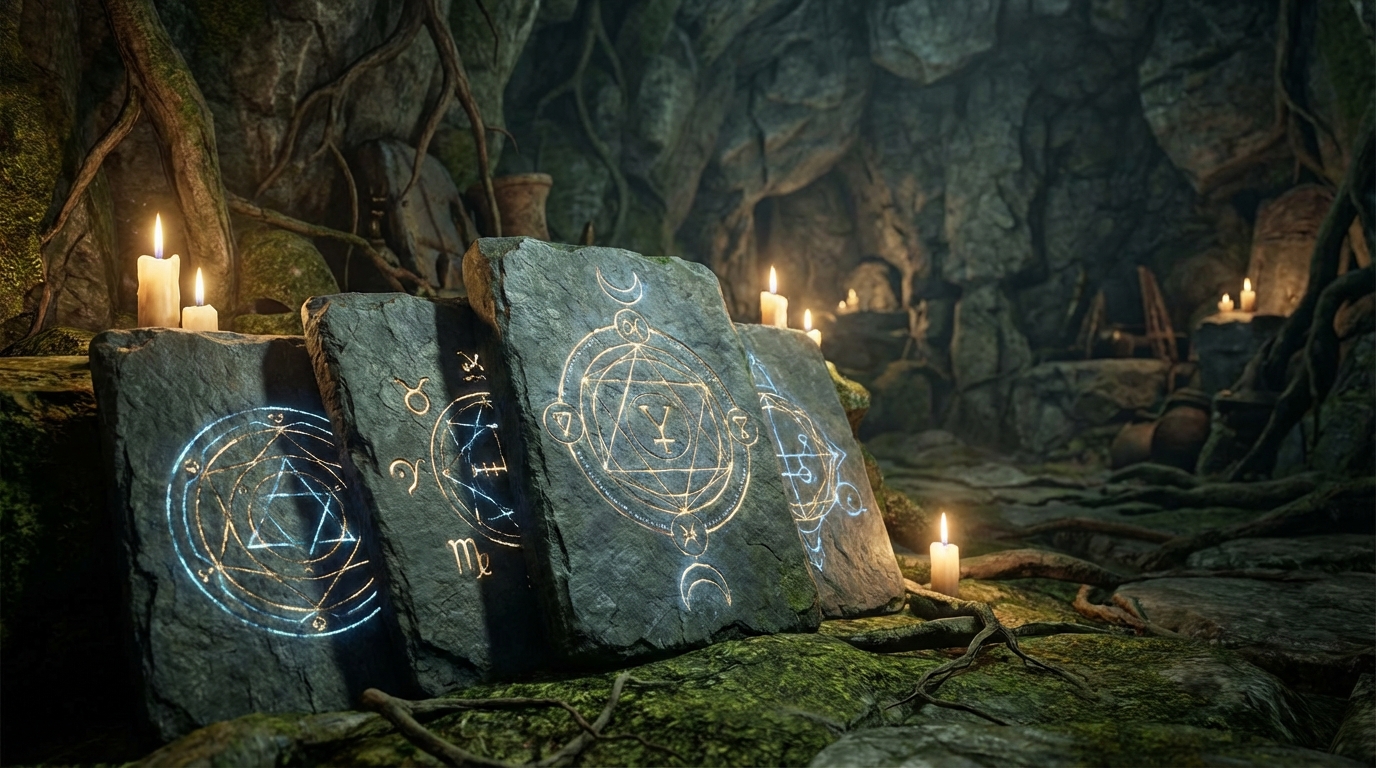
I. The Tradition of Silent Speech: Hermetic Symbols and Their Meanings
The Hermetic tradition, named after Hermes Trismegistus, is a philosophical and spiritual path that emphasizes the direct realization of divine truth. Central to this path is the study of **Hermetic symbols and their meanings**—what the ancients called "silent speech." In Hermeticism, a symbol is not just a representation; it is a repository of power and a roadmap for spiritual ascent, often tied to the principles found in the Corpus Hermeticum.
The Hermeticist views the world as a living book, where every object, animal, and star is a character in a divine alphabet, a concept expanded upon in our Hermetic cosmology. By learning to "read" these symbols, the initiate discovers the hidden laws that govern the universe and their own soul. This is the language of light, the original tongue that existed before the tower of Babel, connecting all humanity to the single source of wisdom.
II. The Master Key: The Caduceus
The Caduceus—a staff entwined by two serpents and topped with wings—is the most recognizable symbol of Hermes and the Hermetic Art.
The Staff represents the central axis of the world (Axis Mundi) or the human spine. It is the steady pillar of consciousness through which power must flow.
The Two Serpents represent the dualistic forces of nature: active and passive, masculine and feminine, solar and lunar. Their winding path describes the balance required to ascend without falling into extremes. They are the Ida and Pingala of the West, the dual currents of vital energy.
The Wings at the top represent the culmination of the work—the liberation of the spirit and the achievement of higher consciousness. The Caduceus is thus a complete map of the spiritual path: from the grounding of the staff to the balance of the serpents, leading to the flight of the soul.
The Scepter of Hermes
The reconciliation of opposites through divine mediation.
III. The Eternal Return: The Ouroboros
The Ouroboros—the serpent devouring its own tail—is one of the oldest symbols in the world, central to both Egyptian and Greek Hermeticism. It represents the cyclical nature of the universe: the constant flow of energy where life and death, creation and destruction, are part of a single, infinite process.
"All is One" (En to Pan) is the motto often associated with the Ouroboros. It teaches the initiate that nothing is ever truly lost, only transformed. In the alchemical work, it represents the 'fixation of the volatile'—the point where the laboratory process becomes a closed, self-sustaining loop. It is the symbol of the universe as a living, breathing organism that is both the beginning and the end.
IV. The Pillar of Stability: The Sphinx
In Hermetic thought, the Sphinx represents the guardian of the mysteries and the synthesis of the four elements. Composed of the body of a bull (Earth), the paws of a lion (Fire), the wings of an eagle (Air), and the head of a human (Water), the Sphinx is the ultimate symbol of the balanced initiate.
The Sphinx guards the threshold between the mundane and the sacred. To pass the Sphinx, the seeker must "know, dare, will, and keep silent"—the four powers of the mage. It challenges the seeker to recognize their own composite nature and to achieve mastery over the elemental forces within themselves before they can be granted access to the deeper vaults of wisdom.
V. The Seal of Solomon: The Union of Opposites
The Hexagram, or Seal of Solomon, consists of two interlocking triangles. The upward-pointing triangle is the symbol of Fire and Spirit, while the downward-pointing triangle is the symbol of Water and Soul. Their union represents the perfect harmony of "As Above, So Below."
This symbol describes the Coniunctio—the chemical wedding of the soul where heaven and earth meet. It is the star of the macrocosm, reflecting the divine proportions within the human sphere. By meditating on this symbol, the Hermeticist seeks to harmonize their internal contradictions, becoming a vessel for the unfiltered light of the one source.
VI. The Historical Stream of Hermetic Iconography
The history of Hermetic symbols is a journey into the heart of the Western Mystery Tradition. It begins in the syncretic environment of Hellenistic Egypt, where the figure of Hermes Trismegistus emerged from the blending of the Greek Hermes and the Egyptian Thoth. The earliest symbols were found in the magical papyri and the "technical" Hermetica, which described the preparation of talismans and the transmutation of metals. These symbols were seen as direct revelations from the divine mind, meant to anchor spiritual forces in the material world.
As the tradition moved through the Islamic world, the symbols were refined and systematized by scholars like Zosimos of Panopolis and later the Sabians of Harran. They introduced the concept of the "Celestial Script"—a series of glyphs that mirrored the structure of the cosmos. During the European Renaissance, the rediscovery of the *Corpus Hermeticum* led to a proliferation of Hermetic art and notation. Masters like John Dee, with his *Monas Hieroglyphica*, attempted to create a single, "Universal Symbol" that would explain the entire universe through a series of geometric transformations.
In the 18th and 19th centuries, the Hermetic symbols were preserved and expanded by the Rosicrucian and Freemasonic orders. The symbols became the primary curriculum for the initiate, representing the various degrees of spiritual understanding. Even today, in the era of digital information, Hermetic symbols persist in our architecture, our logos, and our popular culture—often hidden in plain sight. For the student of the ARCANUM, these symbols remain the "Standard of the Soul," a timeless language that allows the modern seeker to converse with the sages of the past.
VII. The Metaphysics of the Sacred Glyph
Esoterically, every Hermetic symbol is a **Microcosm of the Great Work**. A symbol like the [Ouroboros](../symbols/hermetic-symbols.html#eternal-return) is not just a picture of a snake; it is a mathematical statement about the conservation of spiritual energy. It represents the *Anima Mundi* in its self-sustaining, eternal aspect. The circle of the serpent defines the boundary between the manifest and the unmanifest, teaching the initiate that all creation is a "Blessed Loop" of divine expression.
The geometry of these symbols is a precise study of **Ontological Relationship**. The vertical line of the Caduceus represents the "Volatile" making itself "Fixed," while the wings represent the "Fixed" becoming "Volatile" once more. This is the heart of the Hermetic dialectic. In the sacred geometry of the tradition, these symbols are the "Keys of the Temple," representing the geometric proportions that allow for the harmonious reception of divine light. Every line, curve, and dot in a Hermetic glyph is a theological intentionality, meant to guide the mind toward a specific station of wisdom.
Symbolically, these glyphs are also linked to the "Seven Liberal Arts" and the "Seven Planetary Spheres." The [Caduceus](../symbols/hermetic-symbols.html#the-master-key) is linked to the sphere of Mercury and the art of Rhetoric—the power of the word to transform reality. The Sphinx is linked to the sphere of Saturn and the art of Logic—the ability to discern truth from illusion. When we contemplate these symbols, we are not just observing images; we are participating in a **Sacramental Vision**. We are training our perception to see the "Internal Fire" that animates all external forms, recognizing the divine signature in even the most mundane objects of our experience.
VIII. Hermetic Interpretation of the Arcane Symbols
The Hermetic symbols are the primary vehicles for the **Principle of Mentalism**. "The ALL is MIND; The Universe is Mental." The symbols are the "Thought-Forms" of the divine mind, translated into a visual medium that the human mind can grasp. The Hermeticist understands that by mastering the symbol, they are gaining a foothold in the mental fabric of the universe. This is the secret of **Hermetic Theurgy**—the use of sacred symbols to align the personal mind with the universal mind.
The symbols also embody the **Principle of Polarity**. Every Hermetic symbol is a resolution of a binary. The [Seal of Solomon](../symbols/hermetic-symbols.html#union-of-opposites) resolves the binary of fire and water; the Caduceus resolves the binary of life and death. The Hermeticist uses these symbols as "Reconciling Forces" in their own lives. When they encounter conflict or confusion, they look to the symbols to find the "Third Way"—the path of equilibrium that leads beyond the veil of duality.
Finally, the symbols relate to the **Principle of Rhythm**. They describe the "Ebb and Flow" of the spirit through the world. The Ouroboros is the signature of the great cosmic rhythm, the "Great Breath" of the universe. By aligning one's own internal rhythm with the rhythm of the symbol, the initiate enters into a state of "Celestial Flow," where their actions are effortlessly in harmony with the divine plan. The symbols are not just static images; they are "Moving Blueprints" that describe the dynamic heartbeat of the living cosmos.
IX. Practical Application: The Art of Living Symbolically
In practical Hermeticism, symbols are used for **Internal Visualization**, **Sacred Architecture**, and **Theurgy**. The "Internalization of the Glyph" is a core practice where the seeker visualizes the [Caduceus](../symbols/hermetic-symbols.html#the-master-key) along their own spine, directing the serpents of energy to ascend toward the wings of the crown. This is the Hermetic equivalent of Yoga, a deliberate method for raising one's vibratory rate and achieving states of expanded awareness.
In [Magical Rituals](../rituals/hermetic-rituals.html), the symbols are used as "Beacons of Intent." The Ouroboros is drawn as a circle of protection around the ritual space, while the Seal of Solomon is used to "Bind" or "Release" specific spiritual influences. However, the true practical application lies in "Developing the Symbolic Eyes." This is the ability to see the Hermetic patterns unfolding in our daily lives—recognizing the "Sphinx" in a difficult decision or the "Caduceus" in a successful negotiation. By viewing our lives through the lens of the symbols, we transform our existence into a "Sacred Drama," where every event is a step toward our eventual illumination.
For the modern seeker, the practical application of Hermetic symbols is found in the "Synthesis of Knowledge." We use the symbols as "Filing Cabinets for the Soul," organizing our diverse experiences and insights into a coherent, sacred framework. The symbol of the Sphinx reminds us that we are the "Guardians of our own Mysteries." By holding the Hermetic symbols in our awareness, we commit ourselves to the "Triple Path" of the sage, the priest, and the king. We become the "Messengers of the Light," carrying the ancient wisdom of Hermes into the heart of the modern world, ensuring that the "Language of Light" remains a living, breathing reality for all who seek the Truth.
"True, without falsehood, certain and most true." — The Emerald Tablet