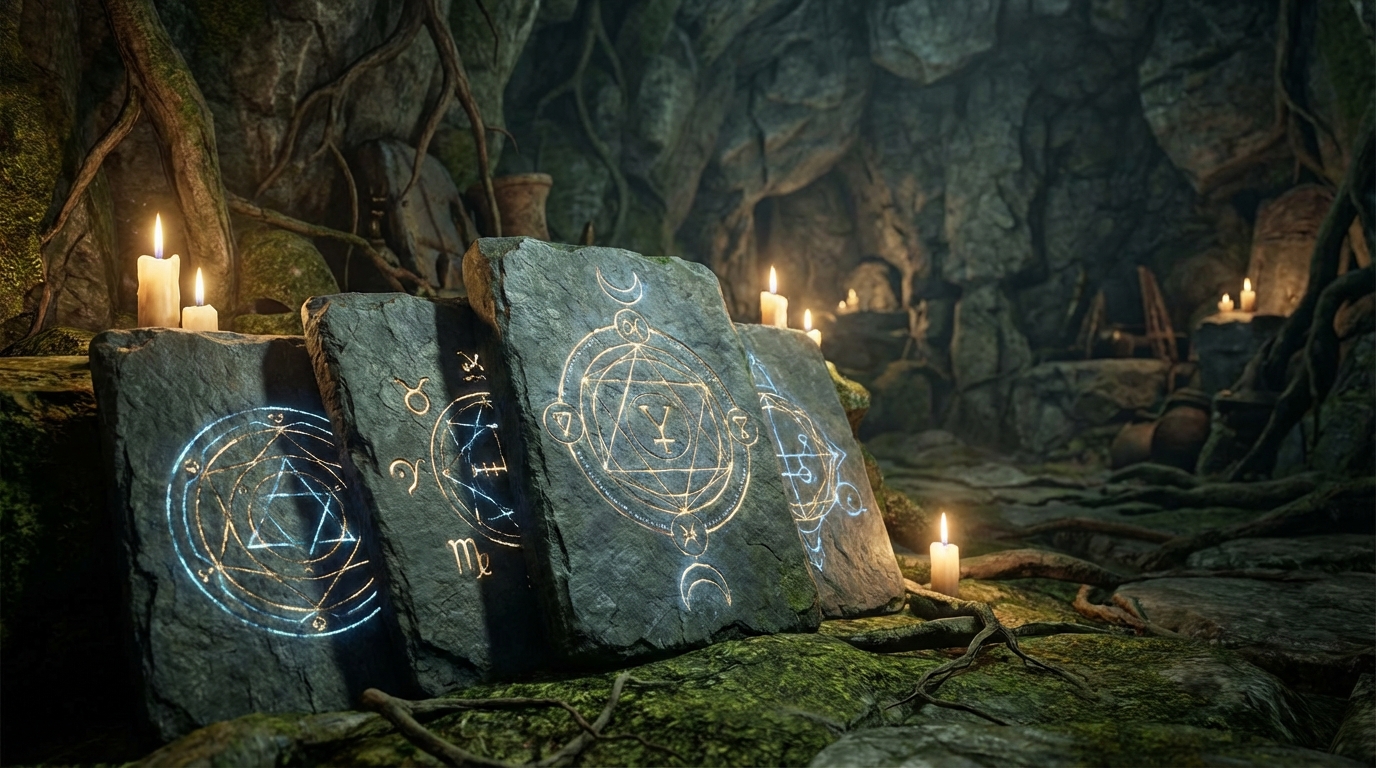
I. The Secret Alphabet of Alchemical Symbols and Meanings
This page maps alchemical symbols as a complete symbolic grammar: the classical elements, the Tria Prima of sulfur, mercury, and salt, and the operations and stages of the Great Work. Its focus is the structure of the system and how its parts relate, as outlined in foundational texts like the Emerald Tablet .
Because the alchemical tradition was often suppressed or viewed with suspicion by orthodox authorities, practitioners developed a highly complex system of 'Decknamen' (cover names) and cryptic glyphs. These symbols, often cross-referenced in our symbols encyclopedia and correspondence tables , were intended to reveal the truth to the worthy while concealing it from the "puffers"—those who sought only material wealth. This symbolic language allows the alchemist to communicate universal truths across cultures and centuries, bypassing the verbal mind to speak directly to the deeper layers of the soul.
II. The Foundation: The Four Elements
At the root of alchemical theory lies the doctrine of the four elements, each represented by a simple triangular glyph. These are not the physical substances of earth, water, air, and fire, but rather the underlying principles of materiality.
Fire
Hot and Dry. The upward-reaching force of transformation and spirit.
Water
Cold and Moist. The downward-flowing force of intuition and soul.
Air
Hot and Moist. The expansive, mediating force of the intellect.
Earth
Cold and Dry. The stable, grounding force of the physical body.
III. The Tria Prima: Sulfur, Mercury, and Salt
As alchemy evolved, Paracelsus introduced the concept of the Tria Prima—the three prime substances that compose all things. These symbols represent the energetic structure of both the macrocosm and the microcosm.
Sulfur (Spirit)
Sulfur represents the active, masculine principle—the volatile heat that drives change. In the human psyche, it is the will, the passion, and the indestructible solar seed. It is the 'Fire that Does Not Burn', the central spark of life that animates the form.
Mercury (Soul)
Mercury is the mediating, feminine principle. It is the 'Universal Solvent' that allows the fixed Sulfur to interact with the material Salt. Mercury represents the fluid mind, the imagination, and the vital spirit that connects the higher realms with the lower.
Salt (Body)
Salt is the fixed, material principle. It provides the vessel or the body in which the spiritual forces of Sulfur and Mercury can operate. It represents the grounding, the physical structure, and the endurance necessary for the Work to reach completion.
IV. The Stages of the Great Work
The alchemical process is traditionally divided into three or four color-coded stages, each with its own rich set of symbols.
- 1. Nigredo (Blackness): The stage of decomposition and putrefaction. Symbolized by the Crow, the Skull, or the Tomb. Here, the base material is stripped of its previous form, mirroring the 'Dark Night of the Soul' where the ego must die to make room for spirit.
- 2. Albedo (Whiteness): The stage of purification and washing. Symbolized by the White Swan or the Moon. The blackened material is washed clean of its dross, revealing a pristine, reflective surface. It is the birth of the purified soul.
- 3. Citrinitas (Yellowness): The stage of awakening and solar illumination. Often combined with the final stage in later traditions. It represents the dawning of spiritual consciousness and the stabilization of the inward light.
- 4. Rubedo (Redness): The final realization and the birth of the Philosopher's Stone. Symbolized by the Phoenix or the Red Lion. The King and Queen (Sulfur and Mercury) are joined in a 'Chemical Wedding', resulting in a permanent, indestructible state of divinity.
Dissolution, calcination, coagulation —
the alchemical sequence was never only metallurgical. It is the structural movement your life keeps making when something unresolved attempts to change form. The sequence is already running. The stage you are in has a name.
Reveal The PatternVI. The Historical Genesis of Alchemical Notation
The lineage of alchemical symbols is a complex tapestry woven from the threads of Egyptian metallurgy, Greek philosophy, and Islamic science. In the laboratories of Hellenistic Egypt, the earliest "Chymists" used symbols to denote the seven metals of antiquity, linking them to the seven planets. These symbols were viewed not as arbitrary labels, but as the "True Names" of the substances—glyphs that captured the essential structural frequency of the metal. The *Leyden Papyrus* and the *Stockholm Papyrus*, dating to the 3rd century CE, contain the nascent forms of the symbols for gold (the Sun) and silver (the Moon), establishing the foundational link between the celestial and terrestrial realms.
The tradition was significantly expanded by the Islamic alchemists of the Golden Age, such as Jabir ibn Hayyan (Geber). They introduced the "Sulfur-Mercury Theory" of metals, which necessitated the creation of new symbols to represent these philosophical principles. The symbols became increasingly sophisticated, incorporating geometric elements that described the "Hot," "Cold," "Moist," and "Dry" qualities of a substance. By the time these texts reached Latin Europe in the 12th century, the symbols had become the universal shorthand of the "Hermetic Brotherhood," allowing scholars like Albertus Magnus and Roger Bacon to share secrets without the risk of discovery by the uninitiated.
During the 17th century, the era of the "Chemical Revolution," the symbols reached their peak of complexity. Alchemists like Elias Ashmole and Michael Maier utilized highly artistic and layered glyphs in their publications, such as the *Atalanta Fugiens*. These images were designed to be "Open Secrets"—visual meditations that would trigger a spiritual awakening in the viewer. Even as modern chemistry began to emerge with Robert Boyle and later Antoine Lavoisier, many alchemical symbols persisted, eventually evolving into the periodic table notation we use today. However, for the Hermeticist, the original glyphs remain the superior language, as they speak to the qualitative and spiritual essence of matter, rather than just its quantitative properties.
VII. The Metaphysics of the Alchemical Glyph
Esoterically, every alchemical symbol is a **Diagram of the Soul's Descent and Ascent**. The circle represents the unformed spirit, the triangle represents the three principles (Sulfur, Mercury, Salt), and the square represents the four elements of the world of form. When an alchemist looks at the symbol for [Antimony](https://arcanumoracle.com/correspondences/metals.html) (a circle surmounted by a cross), they are not just seeing a mineral; they are seeing the spirit beginning its long journey into the density of matter.
The arrangement of the elements within a glyph is a precise statement of **Alchemical Priority**. For example, the symbol for Sulfur (a triangle atop a cross) indicates that the spiritual fire is the dominant force acting upon the material base. The symbol for Mercury (crescent, circle, and cross) describes the "Universal Patient"—the substance that can receive every influence and facilitate every change. In sacred geometry, these symbols are the "Keys of the Kingdom," representing the various ways in which the One becomes the Many and the Many are resolved back into the One.
Symbolically, these glyphs are also linked to colors, smells, and sounds. The *Nigredo* is associated with the color black and the scent of decay; the *Albedo* with white and the scent of lilies; and the *Rubedo* with red and the scent of roses. When we contemplate these symbols, we are engaging in a form of **Sensory Alchemy**, training our minds to perceive the subtle signatures of the divine within the "gross" world of the senses. The symbol is a bridge, a "Vessel of Translation" that allows the alchemist to operate simultaneously in the physical laboratory and the spiritual temple of the mind.
VIII. Hermetic Interpretation of the Transmutation Glyphs
The alchemical symbols are the primary tools for the application of the **Principle of Correspondence**. "As above, so below." The "Iron" in the alchemist's forge is the same "Iron" in the blood of the hero and the "Iron" in the core of the planet [Mars](../symbols/mars-symbol.html). The symbols reveal the interconnectedness of all levels of reality. The Hermeticist understands that by "Treating" the symbol, they are treating the corresponding force in all spheres of existence. This is the foundation of both magical practice and alchemical medicine.
The symbols also embody the **Principle of Vibration**. Every alchemical substance is a specific vibratory rate of the "Prima Materia." The symbols for the various salts, acids, and metals are the "Sheet Music" of the great cosmic symphony. By chanting the names of the substances while visualizing their glyphs, the alchemist "Attunes" themselves to the work. This is the "Spiritual Distillation" of the mind, where the "Leaden" thoughts of the ego are sublimated into the "Golden" insights of the spirit.
Finally, the symbols relate to the **Principle of Polarity**. Alchemy is defined by the tension between the "Fixed" and the "Volatile," the "King" and the "Queen," the "Red" and the "White." The symbols provide the visual framework for this dialectic. Looking at the symbol for the *Rebis* (the two-headed divine androgyne), the seeker sees the ultimate resolution of all binaries. The symbols are a constant reminder that the Great Work is a process of **Reconciliation**—bringing the fragmented parts of the self and the world back into a state of primordial unity.
IX. Practical Application: Living the Alchemical Code
In practical Hermeticism, alchemical symbols are used for **Journaling the Soul**, **Laboratory Precision**, and **Ritual Consecration**. Many modern seekers use these symbols in their "Magical Diaries" to record the shifting states of their own internal "Climate." Marking a day with the symbol of the *Nigredo* is a profound act of acceptance, acknowledging a period of necessary darkness and decay. In the "Internal Laboratory," the seeker uses the symbols as focal points for visualization during meditation, imagining the "Fire of the Spirit" acting upon the "Salt of the Body" to produce the "Elixir of Life."
In the domain of [Alchemical Cooking and Spagyrics](../correspondences/spagyrics.html), the symbols are used to label tinctures and elixirs, ensuring that the spiritual "Signature" of the herb or mineral is respected throughout the process. The symbol acts as a "Guardian of the Intent," preventing the practitioner from slipping into purely materialist thinking. In ritual space, the symbol of the "Philosopher's Stone" is often placed at the center of the altar as the ultimate target of all workings—the state of "Fixed Perfection" that is the goal of every human life.
For the contemporary alchemist, the practical application is found in the "Refining of Character." We use the "Leaden" experiences of trauma and failure as the *Prima Materia* for our growth. We use the "Sulfur" of our will to burn away the "Salt" of our inertia. By holding these symbols in our awareness, we transform our daily lives into a "Sacred Laboratory." Every challenge becomes a "Stage of the Work," and every interaction becomes a "Chemical Reaction." The symbol of the Squared Circle reminds us that we are the "Architects of our own Transmutation," and that the Stone is not something to be found, but something to be **Become**.
"Solve et Coagula — Dissolve and Coagulate."