Sacred Geometry of Creation: The Mathematical Blueprint of the Universe
Introduction
Throughout the history of philosophy, mathematics, and mystical thought, a remarkable idea appears again and again: the universe is built according to hidden mathematical patterns. Ancient philosophers did not view numbers as mere tools for counting. Instead, numbers and geometric forms were seen as the fundamental architecture through which reality itself was structured.
This concept lies at the heart of what later traditions would call sacred geometry. In this view, geometry is not simply a branch of mathematics but a symbolic language that reveals the inner design of the cosmos. Patterns found in nature, planetary motion, architecture, and even the structure of human consciousness were believed to reflect universal numerical principles.
See Your Pattern Live
Start Your Oracle Reading →Across many traditions—including the teachings of Pythagoras, Hermetic philosophy, Jewish mysticism, and Renaissance alchemy—geometry was considered a bridge between the material and spiritual worlds. The shapes that appear repeatedly in nature were thought to represent the underlying harmony of creation.
From the simple point to the complex geometric forms found in sacred architecture, these patterns were interpreted as the blueprints through which the universe unfolds. Understanding these structures is essential for mastering sacred geometry and aligning with the Universal Laws. Those seeking direct insight into why life patterns repeat may consult the ARCANUM Oracle or explore the broader Library archive.
In This Article
The Pythagorean Vision of Number
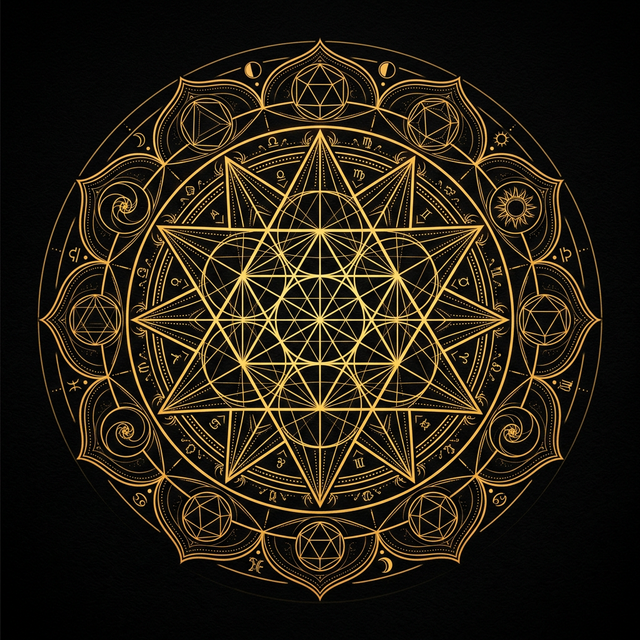
The philosophical roots of sacred geometry can be traced to the teachings of the ancient Greek philosopher Pythagoras. Pythagoras and his followers believed that numbers possessed intrinsic qualities and symbolic meanings. Rather than representing abstract quantities, numbers were understood as expressions of cosmic principles.
The Pythagorean tradition described numbers as possessing great and sublime virtues, suggesting that mathematical relationships governed both physical and metaphysical reality.
The number one, often called the Monad, represented unity and the source of all existence. In geometric form it was symbolized by a single point, the origin from which every line and shape emerges.
The number two, or the Dyad, represented duality. It symbolized the emergence of matter and the division necessary for creation to unfold.
The number three, known as the Triad, represented harmony and balance.
Together these numerical interpretations suggested that numbers were inherent principles governing the universe.
Geometry as the Language of Creation
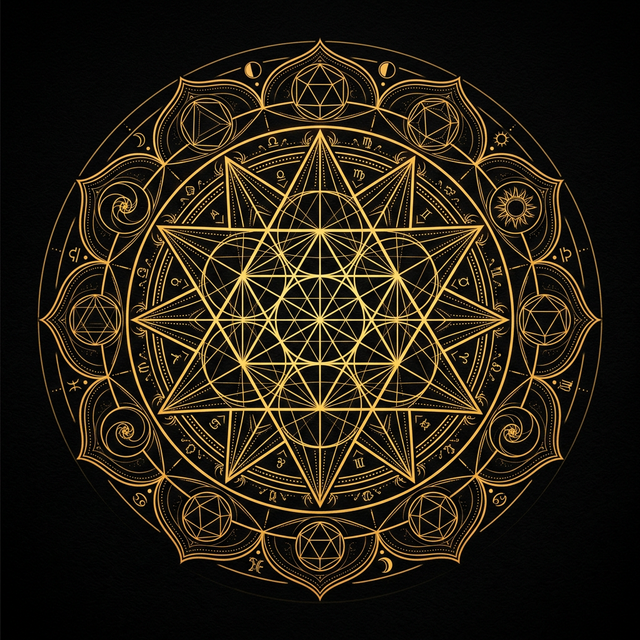
If numbers represented cosmic principles, geometry provided the visual expression of those principles. Geometric forms were believed to embody the mathematical relationships that structure reality.
In sacred geometry, the simplest shapes—points, lines, circles, and triangles—serve as the building blocks of the entire universe.
The circle represents unity and infinity.
The triangle represents harmony emerging from duality.
The square represents stability and structure.
These shapes describe the transition from unity to complexity.
The Platonic Solids
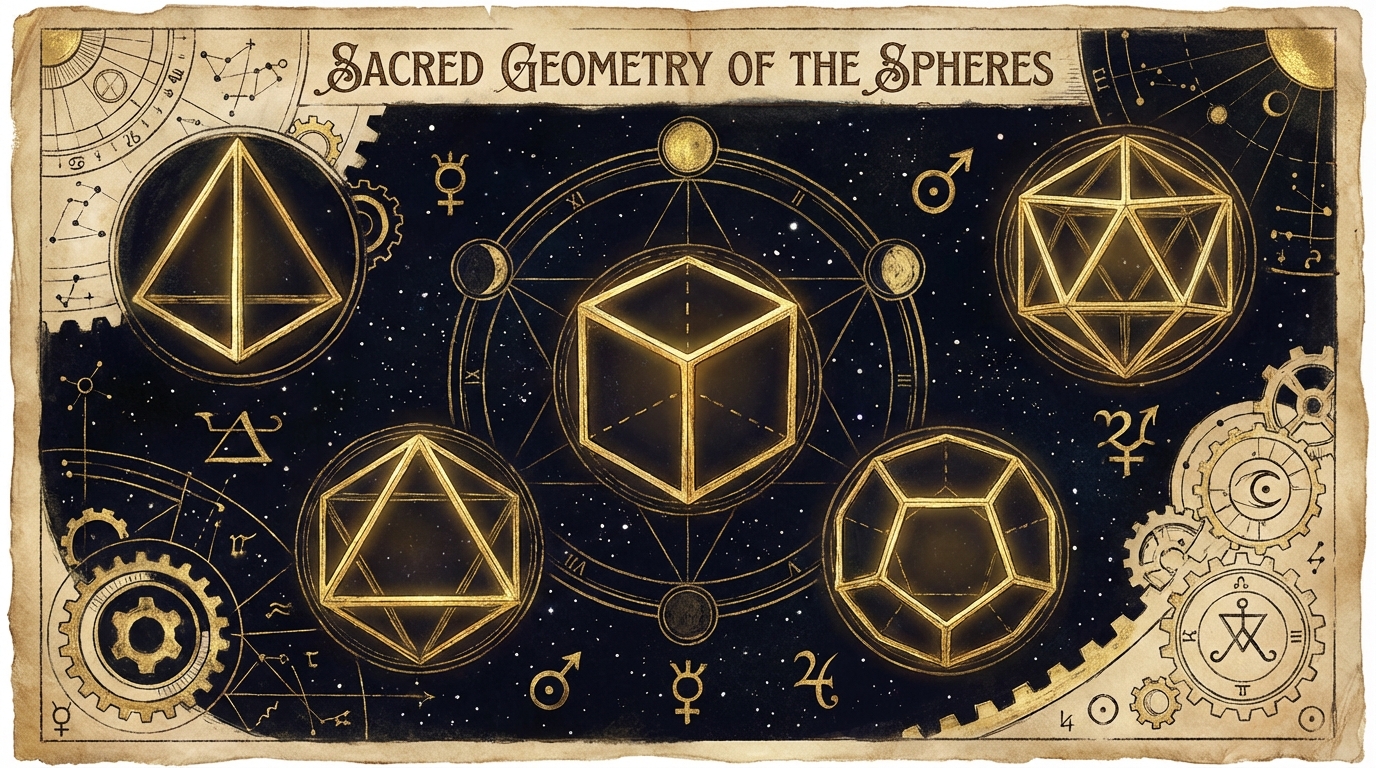
Among the most influential geometric forms in ancient philosophy are the Platonic solids. These shapes possess remarkable mathematical properties: every face is identical, every edge is equal, and every angle is the same.
The tetrahedron was associated with fire.
The cube represented earth.
The octahedron represented air.
The icosahedron represented water.
The dodecahedron was associated with the cosmos.
Sacred Ratios and Cosmic Harmony
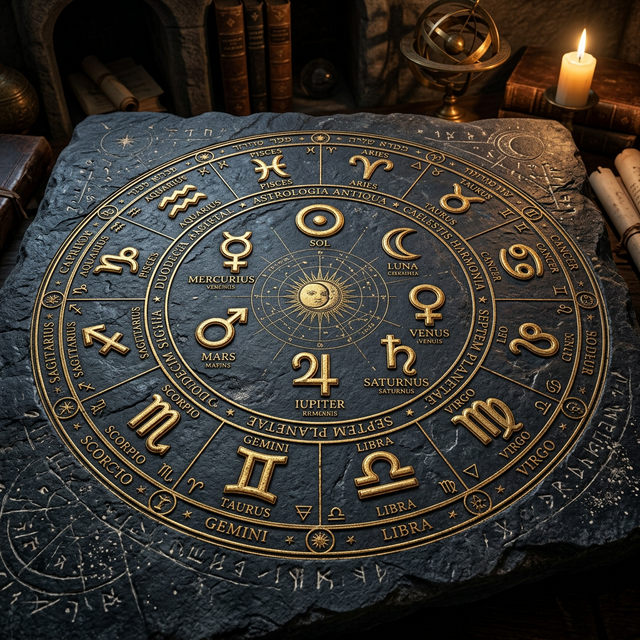
Sacred geometry also explores numerical ratios believed to govern natural harmony. One of the most famous of these ratios is the Golden Ratio. These mathematical proportions ensure that the microcosm reflects the macrocosm, a principle that also governs the shifting planetary hours of the day.
This proportion appears repeatedly in natural forms including spiral galaxies, seashells, plant growth patterns, and human anatomy.
Ancient architects believed this proportion created structures that were aesthetically harmonious because they reflected the same mathematical relationships found in nature.
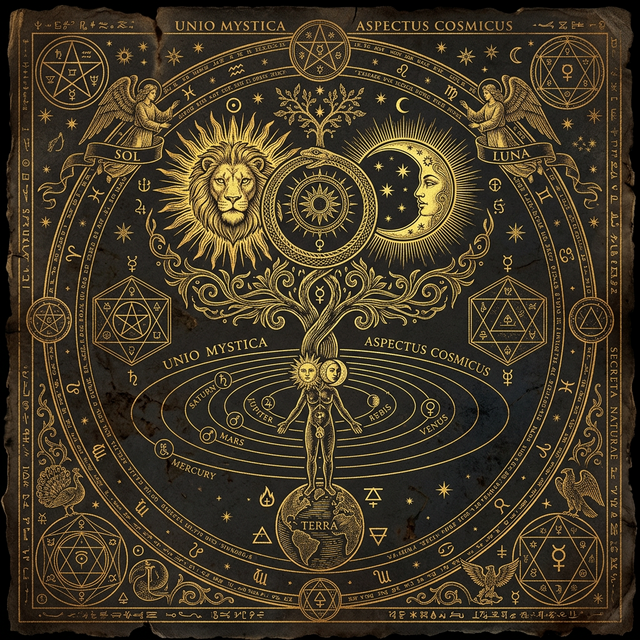
Geometry in Nature
Sacred geometry is not confined to abstract diagrams. The same geometric principles appear repeatedly throughout the natural world.
Hexagonal patterns appear in honeycombs and crystals.
Spiral patterns appear in shells and galaxies.
Branching patterns appear in trees and lightning.
These patterns suggest that nature follows mathematical laws.
Sacred Geometry in Mystical Philosophy
For many ancient thinkers, geometry represented far more than mathematical relationships. It was considered a symbolic language capable of describing the structure of reality itself.
Hermetic philosophers believed that patterns repeat across levels of existence. These patterns connect celestial structures, natural forms, and human consciousness.
Because of this connection, sacred geometry was often used in meditation, architecture, and ritual practice.
Conclusion
Sacred geometry represents one of humanity’s oldest attempts to understand the hidden structure of reality. By studying numbers, proportions, and geometric patterns, ancient philosophers believed they could glimpse the mathematical blueprint underlying creation.
The recurring appearance of these patterns suggests a universe governed by harmony and proportion.
Rather than chaos, the cosmos reveals itself as an elegant system of repeating geometric principles.
Related Insights
Consult the ARCANUM Oracle
If this keeps happening, it’s not coincidence. There is a pattern behind it — one you are not fully seeing yet. The Oracle reveals what is repeating and why.
Invoke the OracleGet Your Personal Cycle Report
Your birth date reveals more than patterns. Unlock your full cycle interpretation instantly.
Reveal Your Full Reading →