Sacred Geometry: The Complete Guide to Universal Patterns and Symbols
Reviewed according to ARCANUM Editorial Standards.
Introduction
This guide gathers the core forms of sacred geometry in one place — the Flower of Life, the Platonic Solids, Metatron's Cube, and the Golden Ratio — along with how each shape has been applied across architecture, art, and the natural world. Use it as a reference for what each symbol is and where it appears, rather than a single continuous history.
This pattern is not random.
It is repeating because you have not decoded it.
👉 Start your free oracle reading:
Start Your Free Oracle ReadingReading about patterns is one thing.
Seeing how it applies to your own situation is different.
Sacred geometry is not merely a decorative art or symbolic system. Instead, it represents a philosophical and mathematical attempt to understand why certain shapes, proportions, and ratios appear repeatedly throughout the natural world. From the spiral patterns of galaxies and seashells to the arrangement of leaves on plants and the proportions of ancient temples, these geometric relationships appear to form a universal language embedded within the structure of reality.
See Your Pattern Live
Start Your Oracle Reading →Ancient civilizations recognized this mysterious order and integrated it into their architecture, art, and religious symbolism. Egyptian temples incorporated geometric proportions aligned with astronomical observations. Greek philosophers explored the connection between mathematics and the structure of the universe. Medieval scholars studied geometry as a reflection of divine harmony.
At the center of this tradition lies a powerful idea: geometry represents the blueprint of creation. This mathematical blueprint is the primary structure of our reality, governed by the 7 Universal Laws . When these geometric relationships are disrupted, unfolding life patterns often lose their harmony and begin to recycle without progress.
Understanding sacred geometry therefore requires exploring the intersection of mathematics, philosophy, cosmology , and symbolic thought. It reveals how ancient thinkers perceived the universe as an ordered system governed by patterns that repeat across every level of existence.
Before proceeding, we recommend consulting the ARCANUM Oracle for immediate cosmic insight, or browsing our Knowledge Library for related mystical research.
The Origins of Sacred Geometry
The origins of sacred geometry extend deep into ancient history. Long before modern mathematical notation existed, early civilizations observed recurring patterns in nature and recognized that certain geometric relationships appeared consistently throughout the natural world.
Ancient Egypt provides some of the earliest examples of sacred geometry in practice. Egyptian architects constructed temples and pyramids using precise geometric proportions believed to reflect cosmic harmony. The Great Pyramid of Giza demonstrates remarkable mathematical relationships that have fascinated scholars for centuries.
In ancient Greece, philosophers such as Pythagoras proposed that the universe was governed by numerical harmony. According to Pythagorean philosophy, numbers and geometric relationships formed the fundamental structure of reality.
Plato later expanded these ideas in his philosophical works. He proposed that perfect geometric forms represented the underlying patterns that shaped the material world. Plato introduced the concept of the Platonic solids, symmetrical three-dimensional shapes that were believed to correspond with the classical elements of nature.
These philosophical ideas eventually spread across many intellectual traditions, influencing Hermetic philosophy, Renaissance architecture, alchemical symbolism, and mystical cosmology.
The Flower of Life
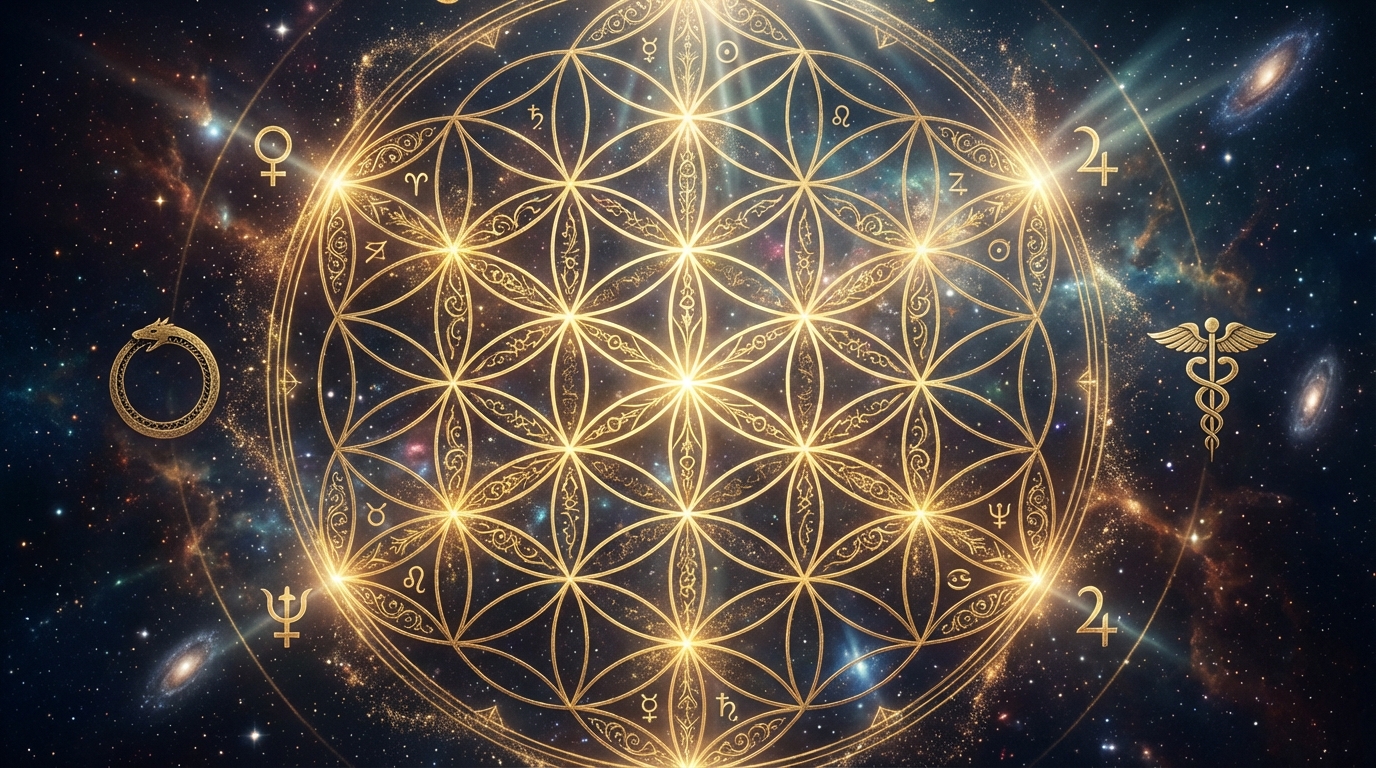
One of the most famous symbols associated with sacred geometry is the Flower of Life.
This pattern consists of overlapping circles arranged in a symmetrical hexagonal grid. The design appears in ancient temples, manuscripts, and artworks across different civilizations, suggesting that it held symbolic significance for many cultures.
Within the Flower of Life pattern, numerous geometric structures can be derived. Hidden within its design are shapes such as the Seed of Life, the Tree of Life configuration, and the structure known as Metatron’s Cube.
Because so many geometric relationships emerge from this simple pattern, some researchers believe the Flower of Life represents a kind of geometric seed from which more complex structures can be derived.
The Platonic Solids
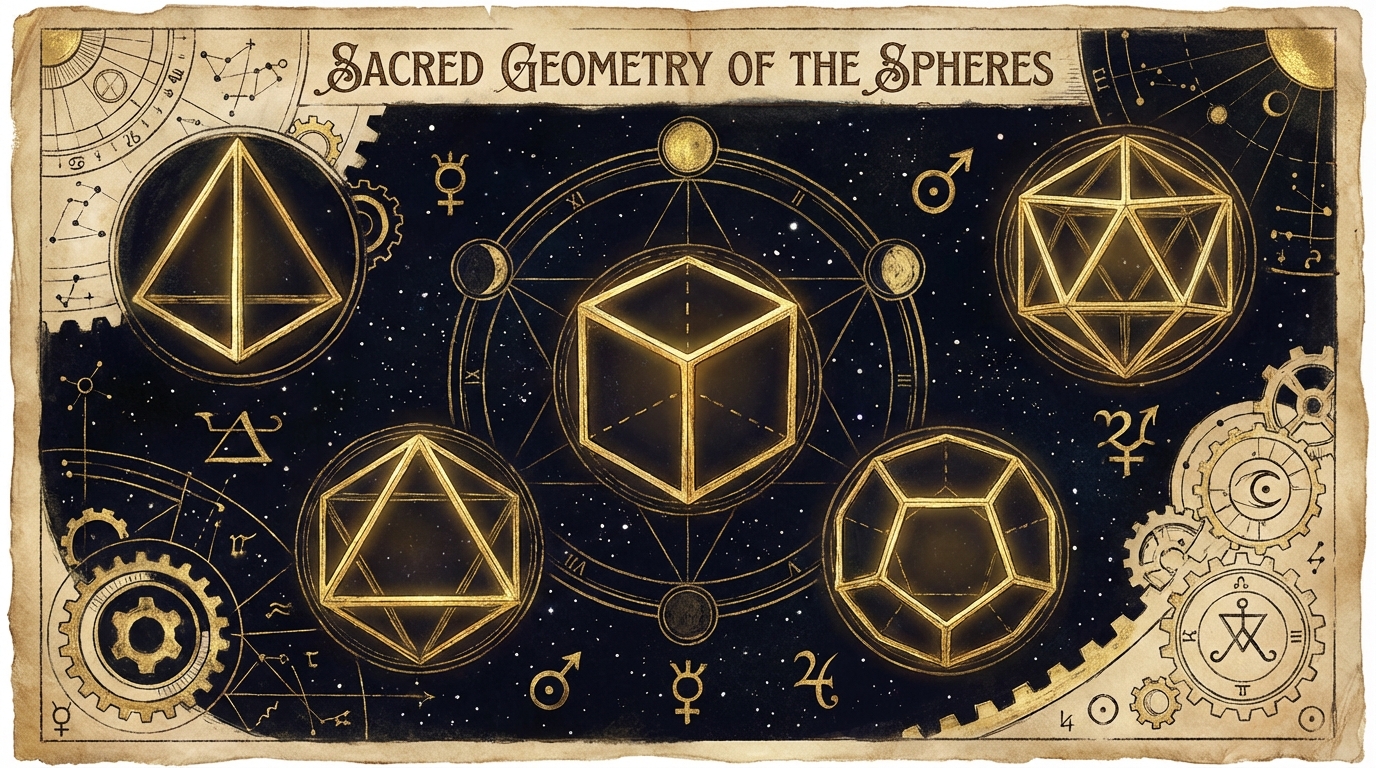
The Platonic solids represent one of the most important concepts in sacred geometry.
These five shapes are the only three-dimensional solids with identical faces, angles, and edges.
They include:
- Tetrahedron
- Cube
- Octahedron
- Dodecahedron
- Icosahedron
Ancient philosophers associated these shapes with the classical elements.
The tetrahedron symbolized fire.
The cube represented earth.
The octahedron corresponded with air.
The icosahedron represented water.
The dodecahedron symbolized the cosmos.
Although modern science no longer interprets these shapes symbolically, symmetrical geometric structures remain fundamental in many areas of physics and chemistry.
Metatron’s Cube
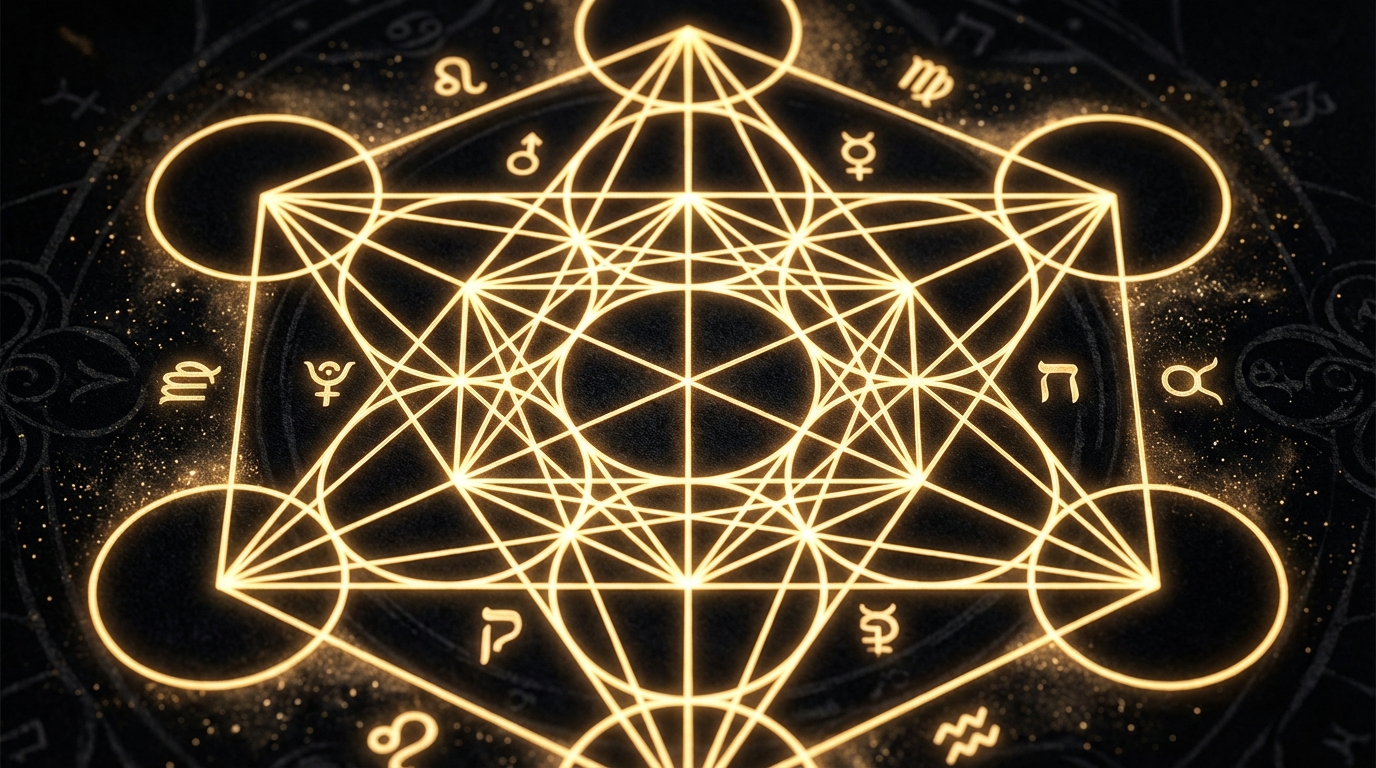
Metatron’s Cube is one of the most complex diagrams within sacred geometry.
This structure emerges from the Flower of Life pattern and consists of thirteen interconnected circles connected by straight lines. When these lines are drawn, the diagram reveals all five Platonic solids hidden within its structure.
You are seeing this because the pattern is active right now.
If you ignore it, it will repeat again.
👉 Reveal your pattern here:
Start Your Free Oracle ReadingBecause of this property, many mystical traditions interpret Metatron’s Cube as a geometric blueprint of creation.
The name comes from later mystical traditions in which Metatron is described as a celestial intelligence associated with cosmic order and knowledge.
Regardless of interpretation, the diagram remains a remarkable example of complex geometry emerging from simple patterns.
This is not random.
The same structure often appears across different people, periods, and decisions long before it becomes visible consciously.
Identify The StructureThe Golden Ratio
Another fundamental concept associated with sacred geometry is the Golden Ratio.
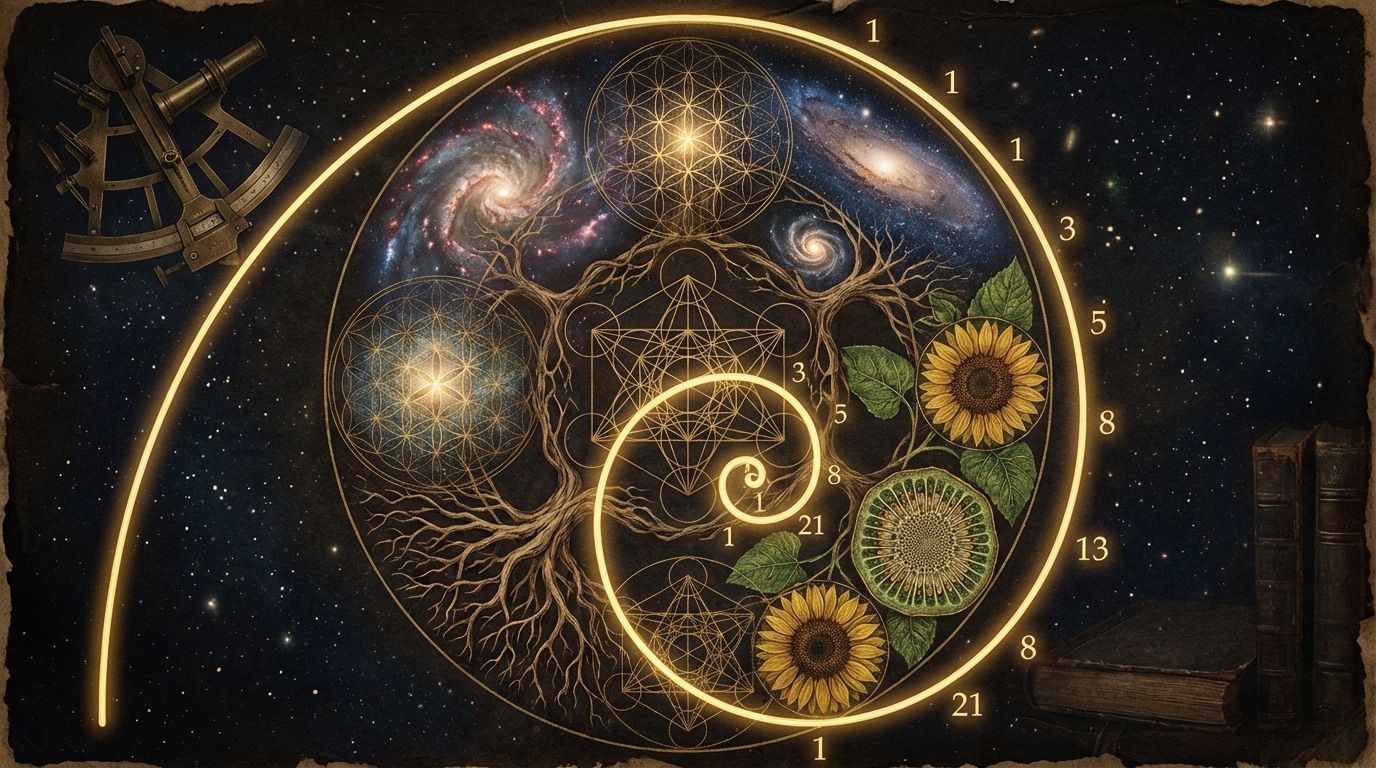
The Golden Ratio equals approximately 1.618 and appears when a line is divided into two segments such that the ratio between them remains constant.
This mathematical relationship appears in many natural structures, including plant growth patterns, shell spirals, and biological forms.
Artists and architects throughout history have used the Golden Ratio to create visually harmonious compositions.
The Golden Spiral, derived from the Fibonacci sequence, represents one of the most recognizable visual expressions of this ratio.
Sacred Geometry in Architecture
Sacred geometry has played a central role in architecture for thousands of years.
Ancient temples, pyramids, and cathedrals were often constructed using geometric proportions believed to reflect cosmic harmony.
Egyptian pyramids, Greek temples, Gothic cathedrals, and Renaissance buildings all incorporate geometric relationships designed to produce balance and aesthetic harmony.
Builders believed that these proportions created sacred spaces aligned with the structure of the cosmos.
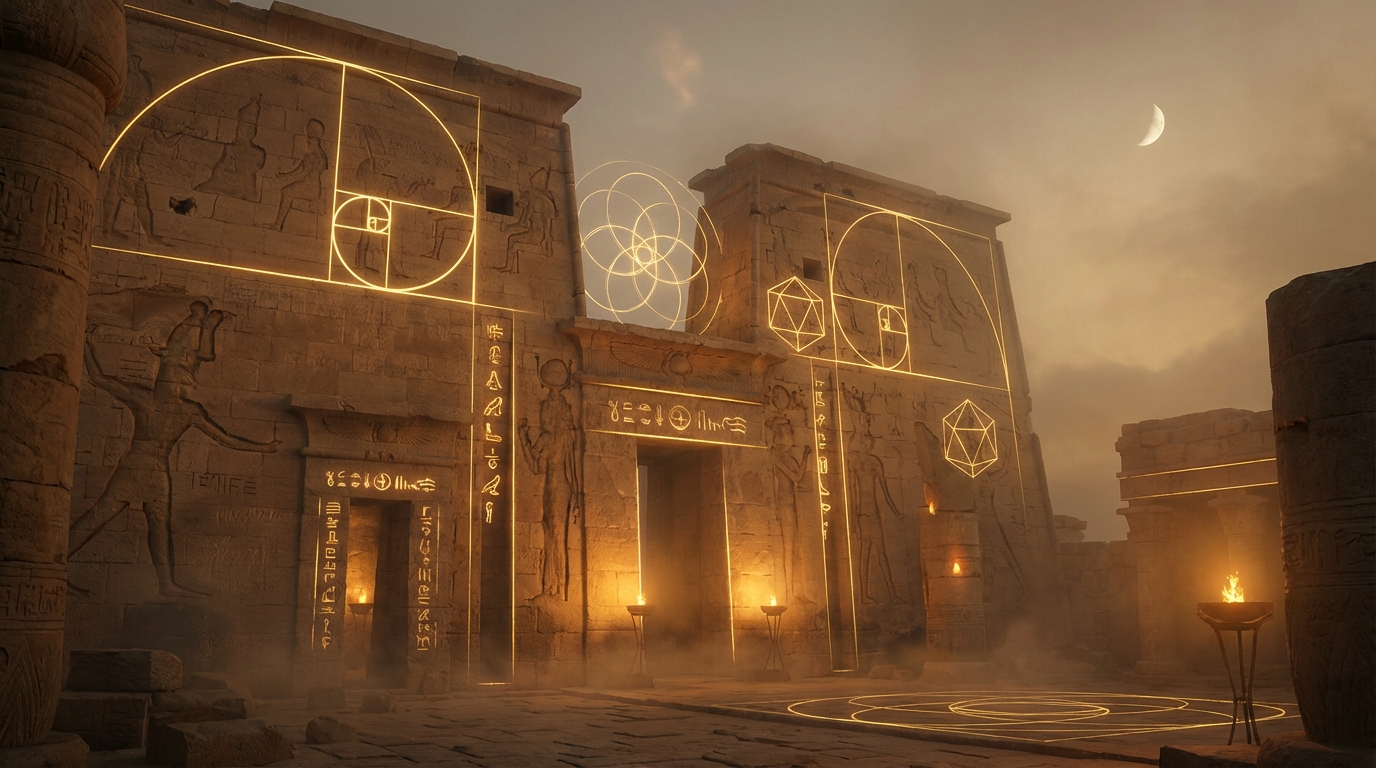
Sacred Geometry and the Structure of the Cosmos
Ancient philosophers believed that geometric patterns described the structure of the universe itself.
Astronomers used circles and spheres to model planetary movement, while philosophers described the cosmos as an ordered system governed by mathematical laws.
Although modern physics uses different frameworks, mathematics remains central to understanding the universe.
In this sense, sacred geometry represents an early attempt to understand the cosmos through mathematical order.
Conclusion
Sacred geometry represents a fascinating intersection between mathematics, philosophy, and cosmology. Through patterns such as the Flower of Life, the Platonic solids, and the Golden Ratio, ancient thinkers attempted to describe the hidden structure underlying reality.
These patterns continue to inspire artists, architects, scientists, and spiritual seekers today. Whether interpreted as symbolic representations or mathematical structures, sacred geometry reminds us that the universe may be governed by patterns far deeper than what we immediately perceive.
Related Insights
Consult the ARCANUM Oracle
If this keeps happening, it’s not coincidence. There is a pattern behind it — one you are not fully seeing yet. The Oracle reveals what is repeating and why.
Invoke the OracleGet Your Personal Cycle Report
Your birth date reveals more than patterns. Get a fuller interpretation when you want more detail.
Reveal Your Full Reading →Related patterns:
Why Do I Feel Stuck in Life? Why Does My Life Keep Repeating?You don’t need more theory.
You need clarity.
👉 Get your full oracle reading:
Understand the Pattern Behind ThisIf you want to understand how this applies to you: